75 Books in 12 Months

Today is Election Day in the US, and after the “shoot-self-in-the-other-foot” results came out this time last year, I decided the news – which for me was mostly podcasts – didn’t deserve my attention anymore.

I’ve always been a news junkie – from being an early user of Pointcast to listening to podcasts before they were even called that (I downloaded MP3s to a clunky Windows CE phone).

For well over a decade, my habit was a daily soundtrack of quality podcasts, and along with mostly getting through the The Economist audio edition each week. I was super plugged in – probably too plugged in. 

However, somewhere I’d heard that the average book contains something like 100x more effort per word or per hour than a blog post or podcast episode. It made sense – the writing and re-writing of a manuscript, the editors, the fact-checking, the publishing, printing, marketing – there’s just a lot more work there. While the output isn’t guaranteed to be high quality, it’s clear that writing a book requires a lot more effort to create, and involves risk to their reputation by publishing it, than a podcast or a blog post.

So I decided to change the inputs. I stopped listening to pundits and started listening to authors – same hours, but with a very different signal-to-noise ratio. Over the next twelve months, those hours added up to seventy-five books – with the added benefit of a lot more insight and a lot less outrage.


Of course, “reading” is being a bit generous. With my Audible subscription, I listened, with all of those hours of a day when your hands and eyes are occupied but your brain is empty. With a busy house, that meant listening to books while cooking, doing laundry, working out or driving to the mountains. I know it’s not the same as quiet, contemplative reading – but perfect is the enemy of done, and this experience turned out to be surprisingly great.

This meant I turned my idle time into learning time. Some books I finished in a couple of days; others were a lot longer (hello, Steve Jobs at over 25h). So while it wasn’t ideal – and there’s a couple of interactive books on this list I haven’t finished – being a slightly distracted reader is a lot better than an aspiring reader full of (reasonable) excuses.


A few friends I’ve talked to about this lately have asked for recommendations and a list. I’ll share those below, and in the future I’ll have more details to share about why I loved the books I gave 5 stars to. But overall, I’d had a few reflections beyond the obvious that this has been 1000x better than listening to podcasts.

  1. History is underrated. Every generation thinks it’s the apex of progress – and as a creature of the tech industry, I’m probably more susceptible than most to that hubris. Reading history has been educational and grounding; biographies show how our ancestors wrestled with the same greed, courage, and confusion we do – just with worse lighting.
  2. Psychology is endlessly fascinating. We all see the world through the eyes we have, filtered by the experiences we’ve had and moderated by our feelings. Given this is unavoidable, one of the most powerful things we can do is understand ourselves better – more honestly, more clearly. This isn’t about self-help or self-change or self-healing – this is about trying to get to the truth, knowing that all of us are biological filters.
  3. Successful people are all weird – thankfully. This is great news for all of us who don’t try and “fit in” with a crowd. Sure, they’re often talented and they’re always hard working, but they’re also independent thinkers who are comfortable enough in themselves to never stop being curious and learning. Since you’re almost certain to be as weird to be reading my post as I am for writing this, I think that is pretty awesome.
  4. Making time for reflection is the next challenge. While my pace will probably slow now that TeamScore is rocking and rolling, I’m going to keep this “books over podcasts” habit going. However, the challenge I’m still a long way from solving is making the time to reflect, internalize and truly learn from the lessons on these pages (or through these earbuds).

Anyway, onto the list!

American Kingpin: The Epic Hunt for the Criminal Mastermind Behind the Silk Road
⭐⭐⭐⭐⭐

By Nick Bilton (2017). The story of the hunt for Ross Ulbricht, the creator of the “Silk Road” dark web marketplace for illegal drugs and services.

Review: A truly remarkable piece of journalism into a wild story, the journey of Russ Ulbricht from brilliant and frustrated libertarian to digital gangster is incredible. The fact this guy was recently pardoned for his crimes while “the good guys” at the FBI and the grieving parents in Perth continue to suffer is a travesty. An incredible tale by Bilton – he must be as mad as any honest person for how things have played out.

Billion Dollar Whale
⭐⭐⭐⭐⭐

By Bradley Hope, Tom Wright (2018). Exposes the story of Jho Low and the 1MDB scandal, a massive international fraud scheme that siphoned billions from a Malaysian state fund.

Review: Incredible story of absurd extravagance and brazen criminality filled with a lot of color. Seeing a country slightly smaller than my own (Australia), and where I got to do a bit of business school (Penang), be systematically looted by the PM, his family and of course the criminal protagonist of this tale is enough to make your blood boil because the perpetrators appear to have gotten away with it all.

Crossing the Chasm
⭐⭐⭐⭐⭐

By Geoffrey A Moore (1991, 2012). Moore’s classic maps the perilous gap between early adopters and the mainstream market that kills most tech startups. He explains why enthusiasm from innovators doesn’t automatically translate to scale, and how positioning, messaging, and product focus must evolve to cross into the mass market. Still the definitive playbook for moving from promising idea to profitable company..

Review: An oldie but a goodie, the amazing thing about this book isn’t just its staying power – it is how it feels like it more relevant than at any point in the last 20 years. While many of the books here have shaped how I think about building Ascendius and growing the user-base of TeamScore, this book feels like it applies to a world where the audience is fragmented, unreachable and you have to earn the engagement from your ICP.

Flow: The Psychology of Optimal Experience
⭐⭐⭐⭐⭐

By Mihaly Csikszentmihalyi (1990). Introduces the concept of “flow,” a state of optimal experience where a person is fully immersed, focused, and energized by an activity..

Review: The closest book on this list to a religious experience, Mihaly’s book is dense, intense and it reads like the culmination of an incredible mind’s life’s work. I think I’m going to have to read it at least two more times – but I got so much out of the first read (I can still remember where I was standing and what I was looking at when I was listening to certain parts of it), I still recommend it without reservation.

If Anyone Builds It, Everyone Dies: Why Superhuman AI Would Kill Us All
⭐⭐⭐⭐⭐

By Eliezer Yudkowsky, Nate Soares (2024). Presents the argument that the development of superhuman artificial intelligence (AGI) poses an existential risk to humanity and is likely uncontrollable.

Review: A wild and super cerebral story which would be easy to put into the category of scaremongering hyperbole if it wasn’t for the credibility and pedigree of the authors. While understandably heavy on thought experiments – which are actually easy to read and understand, but way too elaborate to re-tell when you want to promote the book – this is a great read if you’re not already taking prescription meds for anxiety.

Invention: A Life of Learning Through Failure
⭐⭐⭐⭐⭐

By James Dyson (2021). James Dyson’s memoir about his life as an inventor and entrepreneur, emphasizing the critical importance of failure and persistence in the design process.

Review: An incredible story from one of the most determined and successful inventors of the last 30 years, Dyson’s autobiography contains both great insights and a lot of spicy opinions about the country he loves (and drives him mad). We had one of those knock-off Amway vacuums growing – reading how rotten they were made me wish we hadn’t. The UK is very lucky to have Dyson – definitely a diamond in the rough.

Man’s Search for Meaning
⭐⭐⭐⭐⭐

By Viktor E. Frankl (1946). A psychiatrist’s memoir of his time in Nazi concentration camps, where he developed “logotherapy,” a belief that the primary human drive is to find meaning.

Review: Understandably regarded as one of the most impactful books of the 20th century, I was surprised by the level of detail and the unvarnished nature of his insights on being in Nazi concentration camps. The psychology insights and lessons weren’t as extensive as I had anticipated given how impactful those insights have been over the years through other work, but this book is essential reading for any thinking person, especially with the echoes of the 1930s today.

Mindset
⭐⭐⭐⭐⭐

By Carol Dweck (2006, updated 2021). Introduces the concepts of the “fixed mindset” (believing abilities are static) and the “growth mindset” (believing abilities can be developed).

Review: A simple concept very well communicated, Dweck provides a great framework for use in business, education and especially as a parent. The examples – and self reflection – about why talented people with fixed mindsets get it wrong are exceptionally valuable.

Outlive: The Science and Art of Longevity
⭐⭐⭐⭐⭐

By Peter Attia MD, Bill Gifford (2023). A guide to longevity that focuses on proactive “Medicine 3.0,” aiming to extend healthspan by preventing chronic diseases rather than just treating them.

Review: Probably the most impactful book on my own personal health journey over the last year and a half, Attia’s clear, thoughtful and vulnerable book about increasing healthspan is mercifully short on preaching and unrealistic dictates, and instead focuses on the why of healthspan with very accessible and sensible tips on what you can do now.

Peak Human: What We Can Learn from History’s Greatest Civilizations
⭐⭐⭐⭐⭐

By Johan Norberg (2025). Argues that historical civilizations achieved greatness by embracing specific values like trust, openness to trade, and innovation.

Review: One of the best books I’ve read all year, Peak Human is witty, well researched and possibly the most nutrient-rich history of humanity that I’ve ever read. You could spend a few semesters studying history in University and only come out with half the insights and lessons from this incredibly written and frankly enjoyable book. The fact he points out that peak civilizations fall when they follow the current playbook of Western leaders is troubling but not at all surprising.

Problem Hunting: The Tech Startup Textbook
⭐⭐⭐⭐⭐

By Brian Long (2023). A textbook for tech founders on how to identify, validate, and solve meaningful problems before building a product.

Review: One of the most recommended books to my Startmate mentees, Brian outlines an excellent playbook for finding, validating and then going to market as an entrepreneur. This is also one of the few books I’ve re-read – it is that good.

Source Code: My Beginnings
⭐⭐⭐⭐⭐

By Bill Gates (2024). Bill Gates’s memoir detailing his early life, his formative experiences with computers, his intellectual development, and the founding of Microsoft.

Review: When the book is this long and it is just the first volume, you’d be right to worry it is going to be a slog. Fortunately, Bill’s style and content is anything but boring, and learning from someone who was right in the middle of the emergence of my industry in his own words is a really special treat.

Steve Jobs
⭐⭐⭐⭐⭐

By Walter Isaacson (2011). The definitive biography of the Apple co-founder, based on over 40 interviews with Jobs and 100+ with friends, family, and colleagues.

Review: Isaacson’s biography of one of the most important players in the technology industry is a tour de force, and it is amazing that at over 650 pages there is hardly a wasted word or unnecessary story. I didn’t take as many lessons away as an entrepreneur from Job’s story as I had expected, but the twists and turns of his journey and especially his later career triumph with NeXT, Pixar and the iPhone make for an incredible and highly entertaining story. And yes, I cried at the end, too.

The Basic Laws of Human Stupidity
⭐⭐⭐⭐⭐

By Carlo M. Cipolla, foreword by Nassim Nicholas Taleb (1976, this edition 2021). A satirical essay outlining five laws of stupidity, arguing that stupid people are a powerful and underestimated force in human affairs.

Review: Ironically not intended to be turned into a book, this impressive satirical essay is closer to the truth than I’d like to admit. The best book for understanding the current American political climate – for the first time (ever?), a coalition of the stupid, led by bandits, has managed to steal the future of the richest country on earth. A must read (which you’ll get through in 2-3 hours).

The Code Breaker: Jennifer Doudna, Gene Editing, and the Future of the Human Race
⭐⭐⭐⭐⭐

By Walter Isaacson (2021). Details the life and work of Nobel laureate Jennifer Doudna and the scientific and ethical revolution of CRISPR gene-editing technology.

Review: A simple concept very well communicated, Dweck provides a great framework for use in business, education and especially as a parent. The examples – and self reflection – about why talented people with fixed mindsets get it wrong are exceptionally valuable.

The Fish That Ate the Whale: The Life and Times of America’s Banana King
⭐⭐⭐⭐⭐

By Rich Cohen (2012). Tells the story of Sam “the Banana Man” Zemurray, a complex and ruthless entrepreneur who built the United Fruit Company and influenced history.

Review: In this incredible story of a truly self-made man and an industry I’d never really thought about, Cohen does an incredible job illuminating the role of the fruit-barons in central to north American trade and the damage that they did to countries which in no small part remain impoverished and weak states to this day.

The Gambler: How Penniless Dropout Kirk Kerkorian Became the Greatest Deal Maker in Capitalist History
⭐⭐⭐⭐⭐

By William C. Rempel (2018). Chronicles the life of Kirk Kerkorian, a secretive and high-stakes deal-maker who built empires in aviation, casinos, and film.

Review: Recommended by one of my YPO Forum mates, Rempel’s biography of Kerkorian was an entertaining and enlightening tale about one of the most impressive entrepreneurs I’d never heard of. Finding myself in Vegas a month or so later and looking around at the town Kerkoiran more than anyone else “built” was also really special. If only his character in his professional life was maintained into his personal life, he could have done even so much more.

The Innovators: How a Group of Hackers, Geniuses, and Geeks Created the Digital Revolution
⭐⭐⭐⭐⭐

By Walter Isaacson (2014). Chronicles the history of the digital revolution, focusing on the collaborative teams and individuals who created computers and the internet.

Review: Issacson’s next book after the runway success of his Jobs biography, this deeply researched historical piece should be essential reading for any tech entrepreneur. The people, their stories and the history of our industry that they created is entertaining and very very well written.

The Money Trap: Lost Illusions Inside the Tech Bubble
⭐⭐⭐⭐⭐

By Alok Sama (2024). A memoir from a tech investor about the excesses, hubris, and illusions of multiple tech investment bubbles and the lessons learned from being in the room.

Review: A fantastic story which weaved memoir and incredible first person stories from a wild time in capitalism with a great life lesson about doing what matters. What a debut book! I also hope to buy him a glass of satisfactory red wine on my next trip to NYC.

The Psychology of Money: Timeless Lessons on Wealth, Greed, and Happiness
⭐⭐⭐⭐⭐

By Morgan Housel (2020). Explores the strange ways people think about money, arguing that financial success is less about knowledge and more about behavior.

Review: This fairly short and easy read is probably the best book in its category that I’ve read. Examples like the story from being a valet in his younger years and noticing that everyone looking at a fancy car was never caring about the driver, and how people conflate acquiring things with earning respect and acceptance were a great antitode to the consumerist world we live in.

The SaaS Playbook: Build a Multimillion-Dollar Startup Without Venture Capital
⭐⭐⭐⭐⭐

By Rob Walling (2023). A guide for entrepreneurs on how to build a successful Software as a Service (SaaS) business through bootstrapping, without relying on venture capital.

Review: While Walling’s historical focus has been on the incrementalism of bootstrapping (his prior book is called “Start Small, Stay Small“), this compendium of tips on building a SaaS company was really on point regardless of whether you’re on the VC track or not. There’s almost nothing about this book I would change if I were writing it myself, which means now I’m not tempted to 😉

Thinking, Fast and Slow
⭐⭐⭐⭐⭐

By Daniel Kahneman (2011). This Nobel-prize winning psychologist summarizes his research on the two systems of thought: “System 1” (fast, intuitive) and “System 2” (slow, deliberate), and the cognitive biases that affect them.

Review: An incredible book from an incredible mind, Kahneman’s “Thinking, Fast and Slow” should be required reading in almost all professional and leadership domains. Unlike other authors on this list who made their case with anecdotes to support their thesis, Kahneman’s memoir or sorts is chock full of specific experiments and analytical data – so much so that it is one of the only books on this list I couldn’t get through in Audiobook form.

Trillion Dollar Coach: The Leadership Playbook of Silicon Valley’s Bill Campbell
⭐⭐⭐⭐⭐

By Eric Schmidt, Jonathan Rosenberg, Alan Eagle (2019). Shares the leadership principles of Bill Campbell, the legendary Silicon Valley executive coach who mentored Steve Jobs, Eric Schmidt, and others.

Review: Rosenberg, Schmidt and Eagle do a great job sharing the insights and experiences of the most influential Silicon Valley leader you’ve never heard of. The willingness to tell stories of Campbell’s career which don’t show him to be a saint, but instead a very real and deep leader, make it all the richer.

1929: Inside the Greatest Crash in Wall Street History – and How It Shattered a Nation
⭐⭐⭐⭐

By Andrew Ross Sorkin (2025). An immersive narrative of the 1929 Wall Street collapse, threading high-flying finance, politics and human folly into the story of a financial empire’s unraveling.

Review: An excellent story expertly told, Sorkin provides a richness and depth to one of the most infamous years in American history – and critically, the many players involved. My only criticism was the lack of the wider lens into the ongoing causes of the Depression. Many are self-evident from the telling, but my only reason for not giving it 5 stars is it felt like it could have been a slam dunk with that extra color.

Bad Company: Private Equity and the Death of the American Dream
⭐⭐⭐⭐

By Megan Greenwell (2024). An investigation into the private equity industry, arguing that its practices of leveraged buyouts are detrimental to workers and the economy.

Review: While it is clear from the title that this is going to be a negative piece about Private Equity in America, Greenwell takes a surprisingly balanced and hyperbole-free look at the industry, leaving the reader to form their own opinions. It reinforces my belief in how messed up it when the takers (using other people’s money no less) are making out like bandits at the expense of the builders, makers and creators who actually make the world a better place.

Building a StoryBrand
⭐⭐⭐⭐

By Donald Miller (2017, reviewed and unavailable, now updated to Building a StoryBrand 2.0 in 2025). Presents the “SB7 Framework,” a 7-part storytelling method to help businesses clarify their message and connect with customers.

Review: Similar to April Dunford’s “Obviously Awesome” (below) but with a more structured 7-step framework for the way to use human’s natural way of learning – story telling – in how you connect with an audience.

Buy Then Build: How Acquisition Entrepreneurs Outsmart the Startup Game
⭐⭐⭐⭐

By Walker Deibel (2019). A guide for “acquisition entrepreneurs,” advocating for the strategy of buying an existing, profitable business rather than starting from scratch.

Review: Walker’s book and insights were spot on, and while it is a bit unfortunate that so many smart people I know are now GP’ing “search funds” to make sure they get paid fees (rather than being true entrepreneurs), the playbook makes a lot of sense and I hope more true entrepreneurs follow his advice.

Drive: The Surprising Truth About What Motivates Us
⭐⭐⭐⭐

By Daniel Pink (2009). Argues that true motivation comes from three internal factors: autonomy (self-direction), mastery (getting better), and purpose (serving something larger).

Review: Pink’s most prominent work does a great job of exploring how success in fields of non-routine work – which is almost all knowledge work today – comes down to having autonomy, mastery and purpose. His focus on managing by outcomes is also laudable, if often impractical since most non-routine work isn’t objectively measurable (in part because it isn’t routine).

Elon Musk
⭐⭐⭐⭐

By Walter Isaacson (2023). A comprehensive biography detailing Musk’s life, risk-taking leadership style, and the inner workings of his companies (SpaceX, Tesla, etc.).

Review: Another great biography from Isaacson, his access to Musk and insights into the 21st century’s greatest entrepreneur before he went completely off the rails in 2024 lets the reader understand the path of a very influential which is incredibly valuable to have before the ultra-right Nazi-salute transition. Makes me want to go and read a biography of Howard Hughes now.

Find Your Why: A Practical Guide for Discovering Purpose for You and Your Team
⭐⭐⭐⭐

By Simon Sinek, David Mead, Peter Docker (2017). A practical follow-up to “Start With Why,” offering step-by-step exercises for individuals and teams to discover their core purpose.

Review: A good practical playbook and follow up to Simon’s incredible “Start with Why” which I still vividly remember reading over a decade ago. I loved hearing how Simon, David and Peter have built a practice around Simon’s ideas. If you’ve read Start with Why, then you probably don’t need to read this, though, unless you’re trying to roll it out through a company.

Going Infinite: The Rise and Fall of a New Tycoon
⭐⭐⭐⭐

By Michael Lewis (2023). Documents the meteoric rise and catastrophic collapse of Sam Bankman-Fried and his cryptocurrency exchange, FTX.

Review: Lewis has seen a lot, and you get the sense reading Going Infinite that he is just as confused and off-balance as the rest of us as the FTX story unfolds. The good fortune of his “fly on the wall” timing to be there through the apex of the FTX story was incredible, and the fact the book was written when the story wasn’t fully done made it even more interesting. SBF is a sympathetic is completely all over the shop character, and given FTX shareholders will make a profit (even after the scam of bankruptcy fees), as well as the fact he didn’t pay hitmen like Ulbricht, means I can see why the crypto-loving felon-in-chief will pardon him – unless CZ’s bribe for his recent pardon required keeping SBF in prison.

Good to Great: Why Some Companies Make the Leap…And Others Don’t
⭐⭐⭐⭐

By Jim Collins (2001, 2005, 2010). Drawing on rigorous research, Collins identifies what separates merely good companies from truly great ones that sustain superior performance. With concepts like Level 5 Leadership, the Hedgehog Concept, and the Flywheel, he distills timeless truths about discipline, focus, and humility at scale. It’s less about charisma, more about consistency.

Review: Described by another author on this list as possibly the most in-depth and high quality studies of company performance ever undertaken, Collins’ classic has stood the test of time even if some of the great companies (Circuit City, Walgreens, Wells Fargo) subsequently lost their way.

Grit: The Power of Passion and Perseverance
⭐⭐⭐⭐

By Angela Duckworth (2016). Argues that a special blend of passion and perseverance (“grit”) is a more significant predictor of success than innate talent.

Review: Duckworth’s work, paired with the Growth Mindset approach of Carol Dweck, are essential reading for people who want to fulfil their potential and for the parents who want to help their kids do the same. I think Dweck’s view of being growth minded is more important than the sheer perseverance of grit, but if you’re growth minded but weak then you’re not going win, either.

Hooked: How to Build Habit-Forming Products
⭐⭐⭐⭐

By Nir Eyal, Ryan Hoover (2014). This book presents the “Hook Model” — a four-step loop of Trigger → Action → Variable Reward → Investment — that explains how successful digital products become habits for users. It then applies this framework to show how product designers and marketers can increase user engagement, reduce reliance on expensive acquisition tactics, and build products that users return to almost automatically.

Review: A great book which brings together otherwise well explored psychology into a playbook that is essential reading for any entrepreneur or product leader. Unfortunately, most of our industry stopped reading before they got to the later chapter about “doing the right thing”, which seems to have prompted Eyal to write an antidote book to help sooth his conscience – but probably too late.

How to Make a Few Billion Dollars
⭐⭐⭐⭐

By Brad Jacobs (2024). The memoir of serial entrepreneur Brad Jacobs, detailing his methods for building eight billion-dollar companies in different industries.

Review: Brad’s openness to sharing how we found valuable opportunities in what would be a private-equity roll-up playbook except that he actually ran these companies (instead of hiring a CEO and flipping them) was a great read with a lot of insights and unfortunately too many copy-cats trying to take short-cuts now.

In Praise of the Office: The Limits to Hybrid and Remote Work
⭐⭐⭐⭐

By Peter Cappelli, Ranya Nehmeh (2025). Argues against the long-term viability of fully remote or hybrid work, highlighting the benefits of in-person office collaboration.

Review: Cappelli and Nehmeh do a great job of getting beyond the “preference” lens of remote vs office work (which for a lot of folks becomes a psuedo-religious attempt at justifying beliefs) and use data to help make the case for companies either getting back to their pre 2020 “normal” or investing the time and energy into making remote actually work..

Mindstuck: Mastering the Art of Changing Minds
⭐⭐⭐⭐

By Michael McQueen (2023). Explores why people get “stuck” in their beliefs and provides strategies for effectively changing minds (including your own).

Review: Michael’s examples and stories help to frame a playbook for helping to change minds through constructive engagement and understanding. The old adage of “A mind changed against its will will be of the same opinion still” is as true as ever, and in our increasingly tribal and cultural conflicts, his book provides a great and care-led approach to helping to unstuck the minds of others – but most of all, your own. Also loved hearing my brother’s voice for 11 hours of self-narration!

Never Enough: From Barista to Billionaire
⭐⭐⭐⭐

By Andrew Wilkinson (2024). The memoir of Andrew Wilkinson, detailing his journey from a small web design agency to building a $600 million company, and the personal cost of that ambition.

Review: A great and vulnerable story about the challenges of building a great business and then the insights into the benefits of investing in them instead. One of the few books on this list that I recommended to my wife – and that she then read and enjoyed!

Never Split the Difference
⭐⭐⭐⭐

By Chris Voss (2016). Former FBI hostage negotiator Chris Voss brings field-tested psychological tactics to business and everyday life. His “tactical empathy” approach flips conventional wisdom, showing that great negotiators don’t compromise – they connect, listen, and influence through calibrated questions and emotional intelligence

Review: In instant fan favorite – who doesn’t love a book that starts like a lower-competency scene from Heat – Voss’ ability to bring real world experience to the concepts of really taking the time to get yourself into the shoes of the other person (Habit 5 from Covey) and then combining it with the insight that you make your counterparty come up with how you can give them what they want is brilliant. I just wish more salespeople didn’t just read it as a tactic for manipulation as opposed to a call for understanding and empathy to get deals done.

Obviously Awesome: How to Nail Product Positioning so Customers Get It, Buy It, Love It
⭐⭐⭐⭐

By April Dunford (2019). A practical guide to product positioning, teaching companies how to articulate their product’s value so that customers instantly understand it.

Review: Approachable and self-deprecating in a way only Canadian’s can be, April’s positioning book is tight and packed with really useful insights. A great and tighter compliment to Allyson’s Standout Startup.

Sales Pitch: How to Craft a Story to Stand Out and Win
⭐⭐⭐⭐

By April Dunford (2023). A guide on how to craft a compelling sales pitch by using storytelling techniques to stand out and connect with customers..

Review: A great and practical guide to selling with a focus on narrative as the driver to making a great connection with prospects. Builds and extends on her marketing book form 5 years earlier – I just hope her retention and client success book arrives before 2029!

Scarcity Brain: Fix Your Craving Mindset and Rewire Your Habits to Thrive with Enough
⭐⭐⭐⭐

By Michael Easter (2023). Examines how modern scarcity cues hijack our brains and provides methods to rewire habits for contentment.

Review: Easter’s deep dive into the impact of our deep mental patterns of scarcity that drive caving is an entertaining read and the exposes of Vegas Slot/Poker machines from the perch of someone at the University of Nevada, Las Vegas, is compelling. Unfortunately, you get the sense that he wanted the other anecdotes – especially the Iraqi minister and the tribe in the Amazonian jungle – to be more impressive than compelling, leading this book to slip into the Gladwell category (which is no doubt good for sales and being a keynote speaker).

Spam Nation
⭐⭐⭐⭐

By Brian Krebs (2014). An investigative journalist’s deep dive into the shadow economy of organized cybercrime, focusing on the networks that produce spam and malware.

Review: One of the best bloggers on the security beat, Brian went all the way with this story and helped me understand more than anyone else the way the organized digital criminals can cause so much havoc. And that was before crypto made it possible to do real damage with ransomware and pig butchering! Amazing to think that this period in the late 2000s was an innocent age.

Standout Startup: The Founder’s Guide to Irresistible Marketing That Fuels Growth
⭐⭐⭐⭐

By Allyson Letteri (2024). A marketing guide for early-stage founders on how to build a brand and marketing strategy that attracts customers and fuels growth.

Review: Allyson’s book provided a great framework with more span than many other books in the genre for having a great positioning, personality and ICP framework. Her website templates were also super helpful in doing my GTM planning work for TeamScore.

The Algebra of Wealth: A Simple Formula for Financial Security
⭐⭐⭐⭐

By Scott Galloway (2024). Provides a formula for achieving financial security by focusing on stoicism, time management, and strategic (non-traditional) diversification.

Review: Having been a fan of Galloway from the first time I read his posts taking apart WeWork, and then more recently listening to him for a couple of hours a week on his numerous podcasts, I found this more measured and considered advice in book format to be an even better form of Prof G.

The Big Leap
⭐⭐⭐⭐

By Gay Hendricks (2009). Introduces the concept of the “Upper Limit Problem,” an internal barrier that subconsciously sabotages people when they achieve success.

Review: Hendrick’s impactful and well regarded book takes a more scientific approach to making the psychological case to why we naturally have unnecessary mental limits because of our experiences. While it is considered part of the self-help category, I felt it was more a great piece to improve performance psychology vs help yourself out of a rut.

The Cold Start Problem: How to Start and Scale Network Effects
⭐⭐⭐⭐

By Andrew Chen (2021). Analyzes how new networks and marketplaces successfully launch and scale by overcoming the initial challenge of needing users to attract more users.

Review: I was lucky enough to meet Andrew in one of his and Brian’s first Reforge classes in SF, and he continues to get the balance between thoughtful advice and practical experience right. While there’s always the temptation to take a victory lap, he made sure this book was practical and humble.

The Founders: The Story of Paypal and the Entrepreneurs Who Shaped Silicon Valley
⭐⭐⭐⭐

By Jimmy Soni (2022). The detailed story of the “PayPal Mafia” (Elon Musk, Peter Thiel, etc.) and how their collaboration at PayPal shaped Silicon Valley.

Review: As a tech entrepreneur, I’ve known of the “PayPal Mafia” and their outsized impact on our industry for some time, but I’ve frankly never really been impressed with the PayPal product (I remember trying to build an integration with it 15 years ago and thinking it was a steaming pile of high fee garbage – and grateful that Stripe came along instead). Reading this story didn’t change my opinion of the product today, but I did learn a lot about the amazing things the founders did in what I now appreciate a lot more as a pioneering technology.

The Fred Factor: How Passion in Your Work and Life Can Turn the Ordinary into the Extraordinary
⭐⭐⭐⭐

By Mark Sanborn (2004). Uses the story of a postal carrier named Fred to illustrate how passion and service can turn any job into an extraordinary opportunity.

Review: I was lucky to meet Mark a few weeks ago in Colorado, and bought his book on a whim after seeing him MC. I can see how this book and the story has been able to help Mark build an incredible speaking career, and the broad applicability of this simple but impactful story makes this light and easy read also easy to recommend.

The Outsiders: Eight Unconventional CEOs and Their Radically Rational Blueprint for Success
⭐⭐⭐⭐

By William N. Thorndike (2012). Profiles eight unconventional CEOs who achieved extraordinary long-term returns by mastering capital allocation and adopting a rational mindset.

Review: As a thesis, this isn’t the strongest book, but as what amounts to 8 mini biographies of incredibly successful CEOs, it is fantastic. So many lessons to learn, and Thorndike does a great job weaving them together in a way that provides both contrast and mutual reinforcement of the role of CEOs to focus not just on strategy but the need to wisely allocate the capital to make their strategy a success.

The Scout Mindset: Why Some People See Things Clearly and Others Don’t
⭐⭐⭐⭐

By Julia Galef (2021). Contrasts the “soldier mindset” (defending beliefs) with the “scout mindset” (seeking truth) and argues for the superiority of the latter.

Review: A similar albeit subtly different message than Dweck’s 2006 Mindset, Galef makes a good case for keeping an open mind and remaining curious. Similiarly well timed to McQueen’s Mindstuck, this book could provide a good framework for folks stuck defending their worldview to learn from – although I fear the folks who most need to change their mentality are the least likely to do so.

What You Do Is Who You Are: How to Create Your Business Culture
⭐⭐⭐⭐

By Ben Horowitz (2019). Argues that a company’s culture is defined by its actions and virtues, not its stated values, drawing leadership lessons from history.

Review: A good, authentic book from Ben, although The Hard Thing about Hard Things was a hard act to follow!

Who
⭐⭐⭐⭐

By Geoff Smart, Randy Street (2008). Smart’s Who reframes hiring as a repeatable business process rather than a gamble. With a focus on defining clear scorecards, structured interviews, and disciplined selection, it offers a practical playbook for consistently finding “A Players.” The core insight: the biggest mistake companies make isn’t what they do – it’s who they hire.

Review: I’ve been fortunate enough to get to know Geoff at a few events over the years, and he’s the real deal – obviously very smart (pardon the pun) but also genuine and interested in people and making a difference. Given my own track record of making disastrous hires and knowing first hand the millions it cost me, I loved Smart’s way of building the network of talent before you need them. Hiring is a massive gamble – he just helps you put the odds a little more in your favor, especially with his interview process.

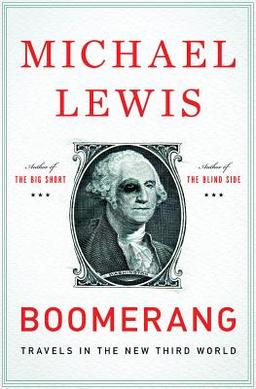
Boomerang: Travels in the New Third World
⭐⭐⭐

By Michael Lewis (2011). A global tour of the post-2000s credit-boom hangover in Iceland, Greece, Ireland, Germany and the U.S., exploring how cheap money spilled across borders.

Review: The most caustic and opinionated of Lewis’ books, Boomerang tells many of the great stories behind the different folks who lost out from the 2008 financial crisis beyond the regular stories of American homeowners ending up underwater. He’s probably not welcome in a lot of countries as a result of this one – perhaps that’s why the book isn’t on Audible anymore?
Build: An Unorthodox Guide to Making Things Worth Making
⭐⭐⭐

By Tony Fadell (2022). Combines memoir and tactical playbook from the designer of the iPod and co-founder of the smart-home company Nest, showing how to build products, teams and businesses that matter.

Review: Tony’s book helps to unpack a process he followed to build some truly iconic products. The focus on the true goal/outcome as opposed to being insecure about how to look like you’re making progress was great.

Designing Your Life: How to Build a Well-Lived, Joyful Life⭐⭐⭐

By Bill Burnett, Dave Evans (2016). The original book that teaches how to use design thinking to create a more meaningful and fulfilling life, regardless of age or career stage.

Review: You can see why Bill and Dave run such a popular program at Stanford, with their practical advice on how to apply design thinking beyond your career lens.

Designing Your Work Life: How to Thrive and Change and Find Happiness at Work⭐⭐⭐

By Bill Burnett, Dave Evans (2020). Applies design thinking principles to help people find more meaning and happiness in their current jobs, without necessarily having to quit.

Review: A structured and thoughtful approach to reflecting on what you love to do, what you’re good at, and how to then apply design thinking to these insights to come up with a path that you can both enjoy and succeed at.

Gap Selling⭐⭐⭐

By Keenan (2018). A sales methodology focused on identifying the “gap” between the customer’s current state and their desired future state.

Review: It feels like there’s a million sales books out there, and the flaw with almost all of them is they could have made their case just as well in 2000 words, not 250+ pages. This book makes a great case – that sales isn’t about the seller, but all about the buyer – but it goes on longer than it needed to.

High Growth Handbook⭐⭐⭐

By Elad Gil (2018). A modern operator’s manual for founders who’ve found product-market fit and now face the chaos of hypergrowth. Drawing from conversations with top tech leaders, Gil breaks down scaling people, culture, operations, and strategy in a pragmatic, no-fluff format. It’s the book you wish you had once growth stops being theoretical.

Review: Elad’s compilation of so many great blog posts, this compendium of advice is rich in rounded insights for entrepreneurs. My main criticism is that, while an angel investor in so many of the companies that went on to become big, a lot of the advice comes from experiences as companies that were already pretty huge when he got there, making this less applicable for early stage operators.

How to F–k Up Your Startup⭐⭐⭐

By Kim Hvidkjaer (2021). Analyzes the common pitfalls and mistakes that lead to startup failure, offering practical advice on what not to do.

Review: A solid and fast moving book that is as filtered as the title, Hvidkjer does a good job pointing out the many landmines in the startup game. That said, I wouldn’t encourage my mentees to read it – they’re better off focusing on the prize, not ruminating on the failures.

Lives of the Stoics: The Art of Living from Zeno to Marcus Aurelius⭐⭐⭐

By Ryan Holiday, Stephen Hanselman (2020). A collection of mini-biographies of the major figures of Stoic philosophy, showing how they applied their principles in their lives.

Review: A great chronological journey through the world of the early stoic philosophers, the narrative was interesting and educational. The applicability is up to the reader – I found it mostly a story without happy endings.

Meditations⭐⭐⭐

By Marcus Aurelius, George Long, Duncan Steen (c 180 AD). The private journal of Roman Emperor Marcus Aurelius, outlining his personal reflections on Stoic philosophy, duty, and resilience.

Review: It is easy to see how this philosopher emperor casts such a long shadow as the last of the Five Good Emperors of the Roman Empire. As a book, it is pretty hard going and definitely not designed to be read cover to cover. It is also easy – and appreciated – to see how Ryan Holiday and others have made this great work much more applicable and digestible. If you want the good stuff, read The Obstacle Is The Way.

Range: Why Generalists Triumph in a Specialized World⭐⭐⭐

By David Epstein (2019). Makes the case that generalists, not specialists, are better primed for success in complex and unpredictable fields.

Review: This was a very enjoyable read and appealed to my own bias to having a wide range of interests and knowledge. However, in the same way that a lot of Gladwell books are interesting, entertaining to read and “make sense”, this story leans a little too much on anecdotes to make its case, which makes it hard to steel-man.

Religion for Atheists: A Non-Believer’s Guide to the Uses of Religion⭐⭐⭐

By Alain de Botton (2012). Suggests that secular society can learn from and adapt the useful aspects of religion (like community, ritual, and moral guidance) without adopting its beliefs.

Review: A cerebral and respectful exploration of the drivers of religion and why an atheist should not throw the baby out with the bathwater. Unfortunately a bit too pompous in style to make it something I can heartily recommend.

Reset: How to Change What’s Not Working⭐⭐⭐

By Dan Heath (2025). Offers strategies to identify when something isn’t working in your life or career and provides a practical guide for making a significant change.

Review: An enjoyable read with lots of practical examples, this book is a useful update to his breakthrough book Switch from 15 years earlier.

The Art of Impossible: A Peak Performance Primer⭐⭐⭐

By Steven Kotler (2021). A high-performance primer that breaks down the neurobiology of “flow” and peak performance to help individuals achieve seemingly impossible goals.

Review: One of the first books I read in late 2024, this was a helpful gateway into a range of fields of performance psychology and excellence. Entertainingly written, Kotler provides a more anecdote driven exposition of the concepts championed by the “Father of Flow”, Csikszentmihalyi. My main criticism is that Kotler assumes the reader is already familiar with the sports-based feats he describes – while they sound impressive enough, if you don’t already know what he’s talking about, it is hard to really get on board with his anecdote-driven thesis.

The Phoenix Economy: Work, Life, and Money in the New Not Normal⭐⭐⭐

By Felix Salmon (2023). Analyzes the post-pandemic economic landscape, arguing that a “new normal” is emerging defined by inflation, labor dynamics, and new market forces.

Review: A prolific blogger and financial industry commentator, Salmon’s first book is well rewritten and dared to be insightful and predictive at a time when things were still very much in flux post pandemic. While not all insights have aged well – “new not normal” turned out not to be done of course – reading it 18 months after it was published was still interesting.

Hidden Potential: The Science of Achieving Greater Things⭐⭐

By Adam Grant (2023). Argues that success is less about innate talent and more about developing the “character skills” and systems to grow and achieve.

Review: Adam’s work is always a great read, but this one felt like a brand extension that didn’t need to be written.

Revenge of the Tipping Point: Overstories, Superspreaders, and the Rise of Social Engineering⭐⭐

By Malcolm Gladwell (2024). A revisit and re-examination of his original “Tipping Point” theory in the context of the modern social media and information age.

Review: As with all Gladwell books, this update to the breakout “The Tipping Point” is a fun read, written in an entertaining and accessible style with anecdotes that stick with you. Also like all of his work that I’ve read, the anecdotes help make a case but the case never really feels strong – emotionally compelling in the moment, but not as strong as many other pieces on this list.

The 38 Letters from J.D. Rockefeller to His Son: Perspectives, Ideology, and Wisdom⭐⭐

By J. D. Rockefeller (2006). A collection of personal letters from J.D. Rockefeller to his son, offering timeless advice on life, work, character, and generosity.

Review: Having previously read Ron Chernow’s Titan, the canonical biography of Rockefeller at almost 800 pages (over 35 hours), I didn’t get as much out of this book of letters as others may. The advice from an aging patriarch to his son trying to fill impossible shoes though are a precious gift and an opportunity to get advice first hand from one of the world’s most successful entrepreneurs.

University of Berkshire Hathaway⭐⭐

By Daniel Pecaut, Corey Wrenn (2017). Compiles 30 years of wisdom from Buffett and Munger’s insightful responses at the Berkshire Hathaway annual shareholders meetings.

Review: As the greatest investor of the last 100 years, Buffet (and Monger) are rightly people to learn from in business. Given their penchant for using their annual reports and their annual meetings as their main (in some years only) ways of making public statements, this summary of those annual meetings and the insights shared within was a good read, if not as nutritionally dense as some other Buffet content I’ve read.

Empire of Al

By Karen Hao (2025). An investigative look into the power struggles, ethical dilemmas, and internal dynamics at OpenAI under Sam Altman’s leadership.

Review: A deeply reported piece in a fast changing and emerging industry from a writer closer to a lot of the players, but unfortunately it loses its punch/impact because the write goes all social justice warrior on how bad it is to pay folks in Africa to tag datasets (perhaps unemployment and hunger are more desirable?). Making this a story about colonialism loses the writer the credibility we need her to have at this time in history unfortunately.

Good Energy

By Casey Means MD, Calley Means (2024). Argues that metabolic dysfunction is the root cause of many chronic diseases and offers a guide to improving metabolic health.

Review: Casey’s book is a strong and passionate exposition of a theory that the root of many health conditions is metabolic health. If she hadn’t then gone down the environmental zealot route with the unsubstantiated claims of everything organic being better for you, she’d have had a bigger impact. Unfortunately, the strong hippie-vibes means it will likely be mostly successful as preaching to the choir.

The Road to Character

By David Brooks (2015). Contrasts “resume virtues” (skills for external success) with “eulogy virtues” (qualities of inner character) and argues for the importance of the latter.

Review: While by no means a regular reader of Brooks’ columns, I’ve often enjoyed his take through the NYT or PBS Newshour when I’ve read/watched them. Unfortunately, this book felt like more of a passion project than something that really needed to be written – if this is a domain you’re interested in, read the 7 Habits by Covey.

Your Next Five Moves: Master the Art of Business Strategy

By Patrick Bet-David (2020). A guide to strategic thinking that teaches how to plan and anticipate outcomes five steps ahead in business and life.

Review: This was one of only two books on this list I couldn’t get through (along with Good Energy above). Perhaps it was style, or perhaps it was because the author is a “creator” who’s best known for creating the “Valuetainment” YouTube channel, but the 50 minutes I gave this title was time I’ll never get back.
Chapter 4: Building Ascendius in Public with AI

After two decades building and running technology companies, I wanted to approach Chapter 4 differently – not by forgetting what I’ve learned, but by questioning everything I thought I knew, because I believe with AI, the rules have changed.

That’s what Ascendius is about – and this post is the first in a series about building it. My goal is simple: build a technology company that generates more than $10 million in annual recurring revenue with fewer than ten full-time employees. This isn’t unheard of, but it won’t be easy, and I’m excited to give it a shot!


The Hypothesis

The hypothesis behind Ascendius – the parent company of TeamScore and what I hope will become a family of sibling products – comes down to three ideas.

1. AI can make talented individuals 5x more productive.
While I’m not sure whether it will be 2x or 5x or 10x, I’ve already seen this firsthand through building TeamScore. AI tools make it possible to plan, write, code, and market faster than ever before – with quality that’s not “good enough,” but genuinely impressive. If that compounding advantage continues, we’ll be able to ship world-class products faster and cheaper than previously possible.

2. Post-AI companies have an unfair advantage.
Starting fresh matters. Established companies have to wrestle with technical debt, organizational inertia, and the politics of change. When you start clean, you can design every workflow, system, and even incentive around AI from the beginning. That’s not just an efficiency gain – it’s structural leverage.

3. Solving the CAC crisis is critical.
Even as it’s become cheaper to build software, it’s become harder to get it in front of the users who need it. Inboxes are scorched earth where we hover over the “report spam” button. No one answers a call from a number they don’t already know. The ad duopoly of Google and Meta extracts every last dollar of marginal spend, while Apple’s 30% outrageous “tax” continues to impair innovation.

So despite the cost of creation dropping, the cost of acquisition keeps climbing. That’s a crisis. 

I don’t know how to solve it yet, but I think the answer lies in combining audience-first thinking, cross-selling across a product portfolio, and AI-driven marketing that’s genuinely helpful rather than spammy. It’s one of the puzzles I’m thinking the most about.


The Productivity Promise

There’s no doubt we’re in the upswing of the AI hype curve. Anyone who’s used AI to do their job knows that feeling of awe when they completed a task way faster than before. However, a recent MIT report also found that 95% of corporate AI pilots are failing. But just like when the internet first emerged 30 years ago, it is clear to anyone who’s used it that this technology is powerful and transformative. 

One of the reasons I think big companies are struggling is because they’re trying to eliminate all of a lower-level role before applying the technology further up the expertise stack. This made sense in the industrial era, where robots did rote, repetitive tasks, but in the post-industrial knowledge economy, AI doesn’t completely eliminate one type of job at a time. Instead, it reshapes every job it touches and often has a bigger impact at the non-routine, non-rote work higher up the experience stack. In my experience, it doubles the productivity of almost every knowledge-based role – including up to the CEO and Board.

That’s the unlock. You can use AI for the things you used to hire an analyst, a marketing agency, or even a strategy consultant to do. For a few dollars a month, and instantly. 

AI is an exoskeleton for talented, creative people – not a replacement for them.

The companies seeing results are the ones where people seek the unlock instead of fearing it. Where AI isn’t a threat, but a multiplier.

At Ascendius, I use AI as an active partner for multiple hours every single day. I use it to brainstorm strategy, design architecture, refactor code, and, of course write 3 or more blog posts a week. The productivity gain isn’t about speed alone – it’s about the quality and breadth of what one person can now achieve.

But what I also know first hand is that “vibing” doesn’t work. I’ve been as excited as anyone to see a prototype come to life before my eyes, and the first version of TeamScore was an MVP alpha built super fast. But whether your coding or writing a legal brief or a consulting report, vibing doesn’t work. As a technology product, vibed code is unmaintainable and often insecure. As a marketing and sales tool, set-and-forget AI tools do more harm to brands and products than they save in time. 

However, if you use AI as a multiplier instead of a replacement, it is transformative.

For example, with TeamScore I was able to build a powerful, multi-region product with two dozen connectors in a programming language I didn’t know on a back end I’d never used in <6 months. It is how I was able to create a 30 page go-to-market plan that should take over 3 months in under 3 weeks. It is how I’ve been able to do detailed analysis of data in a couple of days that would have taken a couple of weeks, and of course how I’ve been able to write this and all of my other blog posts over the last two weeks while doing everything else.

That’s the productivity promise – and it’s already real.


The Advantage of a Clean Start

Most established companies are trying to retrofit AI into organizational structures, processes, and policies built for a pre-AI world.

Those structures weren’t designed to resist change – they were designed to manage risk and maximize the consistency of people. But now, every role, policy, and workflow is a piece of friction resisting change whether actively or accidentally. When people evaluate AI through the lens of how to do their job rather than asking whether their job should exist, progress slows to a crawl.

As Upton Sinclair wrote back in 1934,

“It is difficult to get a man to understand something, when his salary depends upon his not understanding it.”

It’s not malice. It’s human nature. It hasn’t changed in the 90+ years since Sinclair wrote it, and it isn’t going to change any time soon. 

For technology companies, the problem runs even deeper than processes, bureaucracy and politics. It’s not just the people – it’s the code.

Joel Spolsky, the doyen of software engineering and founder of StackOverflow and Trello, wrote the canonical warning more than 25 years ago in Things You Should Never Do, Part I . Rule number one being never rewrite your software from scratch. It was true then, and mostly still is.

But now established technology companies face a paradox. To take full advantage of AI, they need to modernize their infrastructure, data models, and workflows. Yet for any company more than a few years old, doing so requires breaking Joel’s first rule.

While you can bolt AI onto an old codebase, you’re not going to see many benefits – at least not compared to AI-native tech companies.

All of this gets even harder when the company is owned by private equity – where the plan to flip a company in 3-5 years isn’t compatible with the timeline or investment required to take advantage of AI. The founders are gone, the MBAs are in charge, and while they’re good at doing acquisitions and pricing strategy, product and engineering innovation isn’t usually their sport.

That’s why starting fresh is such a competitive advantage. In addition to being able to harness powerful tech like Cursor or Claude Code because your code isn’t legacy spaghetti, there’s also no team defending the old system, no hierarchy to preserve, no compliance department standing in the way of experimentation.

And it’s why this era feels so exciting.

Many of my friends who’ve exited their companies are back at it again – not because they need to, but because it’s rare to get both the experience of having built before and the freedom of a blank slate.

In a world of massive change, that’s the sweetest combination there is.


Solving the CAC Crisis

While AI promises to accelerate the product engine of a tech company, customer acquisition cost (CAC) remains a massive choke pointw

For years, the cost to build a new software product has fallen. But the cost to find customers has continued to increase.

Google and Meta’s action-based advertising duopoly soaks up every incremental dollar of acquisition budget, while Apple’s evil 30% tax and self-preferencing stifles innovation. Old sales playbooks continue to see diminishing returns: the inbox is scorched earth with cold emails quickly getting the “report spam” click, no one answers calls from phone numbers they don’t already know anymore because of scammers.

At the same time, AI will make it even cheaper to build new products. The result is a flood of competition fighting for the same attention, in the same channels, with the same tools.

That’s the CAC crisis.

If this era is going to produce a new generation of durable software businesses, we’ll need new distribution models to match, and being 5x as efficient in your biggest cost – payroll – provides the ability to invest in a better product at a better price along with new go-to-market tactics. These could include audience-driven portfolios, value-based bundling, or deeply automated go-to-market loops that are personalized instead of pushy. There’s also promise in new players providing new paths to discovery – as long as we can keep the AI-slop at bay.

I don’t have the full answer yet. But it’s one of the most interesting challenges in modern entrepreneurship – and I’m thinking about it every day.


Let’s Go!

We’re living through the biggest change in technology since the internet went mainstream 30 years ago – and it might prove even more consequential than that.

For builders, it’s a once-in-a-generation opportunity to rethink everything – not just products, but companies themselves.

So that’s what I’m doing. And if you’re building too, I hope you’ll come along for the ride.

Fixing the Machine: The False Trade-Off Between Health and Success

Running a Company on Empty

Tomorrow marks 21 years since my dad passed away suddenly, and it feels like the right time to share what I’ve learned from finally doing things differently with my health over the last year and a half. 

For most of my career, I told myself I’d focus on my health “later.” Like a lot of entrepreneurs, I thought I was making a rational trade-off: push hard on business now, fix myself later when I’d exited or “had time”.

I’ve since realized it wasn’t a trade-off at all – it was a false choice that made business success less likely and a major health event more likely. Talk about a lose-lose

A few years ago, deep in the post-pandemic grind, I looked at the routine summary you get after a doctor’s office visit, and read at the top alongside my name and date of birth “non-morbidly obese male”. Obese was a rough word to see – and the ‘non’ was doing a lot of work.

So, while I did what I promised and focused on health after selling Accelo, I hope what I learned doing it is useful for other entrepreneurs grinding away every day – in short, don’t wait.


The Basics That Actually Work

The good news is, if you want to improve your health, the fundamentals work even if you’ve ignored them for years. Anyone who’s gotten in shape after a long period of being anything but will tell you it isn’t that hard – but it does take time and commitment. While there’s lots of nuance and advice if you’re an athlete, if you’re a “normal person”, it really comes down to three things:

  1. Eat less – and better – food. This one’s mathematical: if you consume less calories than you burn, you’ll lose weight. This is also where cutting alcohol consumption comes in – booze is super calorie dense. The main change I made was getting 150g of protein a day.
  2. Exercise regularly, especially resistance training. This isn’t actually about burning calories as much as having a strong structure for health, and because muscle burns a lot more calories just to operate, it helps with getting the calorie deficit. But you can’t train your way to weight loss.
  3. Prioritize sleep. There’s no bragging rights for pulling all-nighters the day before a deadline. Building a company isn’t like cramming for exams. You need sleep for good judgment and sound decisions.

Aside from promising myself I’d get in shape post-exit, I had another motivation to get healthy – my three girls. I knew if I didn’t do something about my health, I might not be able to walk them down the aisle one day.

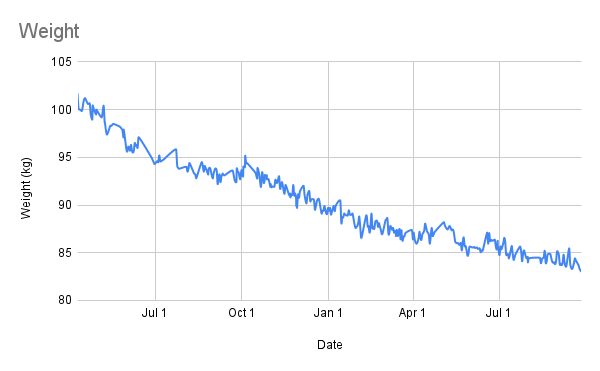
And there was a lot to do. When I started this journey in April last year, I weighed in at almost 102kg (224lbs). I was unfit, sleeping poorly and eating too much (especially snacking).


The New Operating System

While I set a big goal – to get down to 83kg (183lbs) for a healthy BMI for the first time in my adult life – I started small. This was about a sustained change of lifestyle and outlook, not a quick and temporary win:

  • April 2024 – Began on a GLP-1 medication (Ozempic), ramping up over a few months to 1mg/week. I hated needles, but loved the appetite control. It made calorie restriction easier, and that made exercise not just possible but actually enjoyable. There’s ways to do this that don’t break the bank, too.
  • August 2024 – Joined a gym and started strength training with a trainer, Avishai. I knew almost nothing (and still have plenty to learn), and after he moved away in October, I used ChatGPT to take pictures of the equipment in my new gym and then create a workout plan, which I then loaded into Hevy. This syncs with Strava and Fitbit, and helps me track performance.
  • December 2024 – By the end of the year I was down 12kg (26lbs). For the first time in forever, I didn’t create an empty New Year’s resolution around “getting healthy”, but instead just had to stay the course. 
  • September 2025 – In less than a year and a half, I hit my goal! And while I haven’t set a new target yet, I’m now committed to working out at least 5 days a week and continuing to get stronger to be a better father, husband and leader.

While it feels great to have lost 18.7kg (41lbs) so far, the bigger benefit is how much more energy, mental sharpness, and focus I’ve gained. There’s no way those five extra hours I used to spend grinding on the business instead of exercising were worth more than the performance I’ve gained every other waking hour by making health a priority.


What I Learned (and What I’d Tell Other Founders)

Here are a few lessons that stood out along the way – and that I wish I’d understood earlier.

1. Your performance is the company’s performance.
You probably already know this, but when you’re the founder or leader, you are the company’s pace setter. If you’re tired, foggy, and sluggish, your team and decisions are too. You can’t lead on empty.

2. It’s never been easier.
Modern medicine, wearables and AI training tools have changed the game. GLP-1s make calorie restriction sustainable, and an Apple Watch, Fitbit, or smart scale gives more feedback than a doctor’s visit used to. ChatGPT can also help you put together a workout plan. You still have to do the work, but the friction is lower than ever.

3. Most advice is noise.
Like startups, 80% of the results come from doing the most important 20% of things consistently. If you read one thing, make it Peter Attia’s Outlive. Then:

  • Do a resistance workout 2-3 days a week. Lift weights or use machines: whatever works for you. The key is building strength for the long term, especially avoiding injury.
  • Do a cardio workout 2 days a week. 30 mins in Zone 2 (about 120bpm) seems to be the best advice.
  • Stay in a mild calorie deficit. This isn’t dieting or starvation stuff. Only fast if you can’t help yourself around food.
  • Sleep more than you think you can afford. With three young kids and a puppy, I’m still failing at this. But don’t stay up late grinding.

That’s it. The compounding is real.

4. Don’t wait.
I used to think I’d “get healthy once things calm down.” They never do. There’s always a product launch, a funding round, a fire to put out. You wouldn’t go on a road trip with empty tires – don’t try to build a company without also building your strength and physical resilience.


Where I Am Now

My VO₂ max has improved, my blood pressure’s down, and I can lift more than I could at 25. But I’ve still got a long way to go. My sleep is terrible (I’m lucky to average six hours each night), and wine on school nights is still a habit I haven’t fully kicked. But I’m operating at a higher level – physically, mentally, emotionally – than I have in a decade.

I’ve learned that getting healthy isn’t a side project or something for later. It is the main project – because without your health, you can’t build or lead anything that lasts.

Kicking off Chapter 4

Image

When I sold Accelo a year and a half ago, I promised myself something I’d never really given before: a break.

Truth is, I wasn’t great at it. My family will tell you I failed miserably at “learning how to sit still.”

But spending more time with them made me realize something important: if I was going to be the father I want to be, I needed to get into shape.

My own dad died young, and I couldn’t keep being unfit and overweight if I wanted to be around to walk my three girls down the aisle one day. So I did something about it. I dropped over 18kg (45 pounds), got fit, and rediscovered what it feels like to have a body that can keep up with my ambitions.

Back to Building

By the end of last year, I felt the itch again. I wanted to get back into technology. I wanted to build. And I wanted to really get my hands dirty with AI – to figure out what’s real vs hype, and harness it to do things differently for my next startup.

Rather than following tutorials or vibe coding yet another photo app, I decided to actually build a product that I wish I’d always had when running Accelo. At the beginning of this year, I began building TeamScore.

The Problem That Wouldn’t Let Go

Running Accelo, one of the toughest challenges my managers and I faced was managing a remote team – especially one that wasn’t hired to be remote.

When you’re in the office, you have peripheral vision. You see who’s busy, who’s stuck, and where things are slipping. Remote took that away.

I saw that managers were left with three bad options:

  1. Turn into a micromanaging tyrant, staring at the color of lights on Slack, scheduling 5pm Friday meetings and pestering for constant updates. That didn’t fly with us.
  2. Hope for the best, flying blind until problems blew up. And since hope isn’t a plan, surprise surprise, blew up they did.
  3. Install invasive monitoring software on employee devices which that monitors mouse movements, takes screenshots, records browser history and more. While it provided data, spyware is kryptonite for the superheroes on your team. Killing their passion just to get a clearer lens on performance never felt like a trade worth making, and treats your best people like suspects.

That pain stuck with me. I could see remote wasn’t going away, but the more I talked to other entrepreneurs, the more it was clear that remote wasn’t really working, either.

So I decided to build TeamScore.

What I’m Building

TeamScore is a zero-footprint, instant-setup platform that transforms the cloud security logs companies already have into AI-powered insights for managers.

No spyware or agents on employee devices. Just clear, actionable visibility into what your team is actually working on – so you can make remote work.

It’s the tool I wish I’d had, and the one I believe many managers and entrepreneurs need today. And today it is being launched into public beta – join the waitlist at app.teamscore.io/sign-up.

I was determined to make Chapter 4 different – drawing on the lessons of helping more than 5,000 businesses succeed in my prior startups, but not just running the same playbook again.

AI has changed the game. Its rapid progress makes it possible to build technology faster, leaner, and more affordably than ever before.

That’s why the goal for TeamScore is ambitious but focused: to build a $10M ARR startup serving over 100,000 businesses while keeping headcount to under ten full-time employees. Not by cutting corners, but by building smart, automating what can be automated, and keeping the team razor-focused on what matters.

And TeamScore is just the start. My vision is to launch a family of products designed to help entrepreneurs and their businesses thrive—ideally one new venture each year. TeamScore is the first step, and it won’t be the last.

It’s been an incredible journey so far, and I’ll have plenty more to share in the months ahead. But today I’m excited to say: TeamScore is ready for public beta.

Read the TeamScore launch post here.

Closing Thoughts

Time off reminded me I’m bad at sitting still. Getting healthy reminded me that discipline pays off. And starting again reminded me that the best problems to solve are the ones you’ve lived yourself.

So here we go. Round 4. Let’s gooooo!

COVID Comparisons

Throughout the COVID-19 Pandemic there’s been plenty of scary headlines, statistics and tragic individual stories. One thing I’ve rarely seen, though, is a comparative base for understanding the statistics that drive the scary headlines.

To help with my own understanding, I’ve compiled a couple of comparable statistics (with sourcing) so I don’t have to memorize them, and am publishing them here in case it is helpful for others too.

Key Statistics – Hospitalizations and Deaths per 100K people

First, a disclaimer: I’m not an epidemiologist – I’m just a guy trying to make sense of a lot of important information to make clear-eyed decisions for my family and team in a very charged and dynamic environment.

With this in mind, I generally think about the Pandemic risk in relative terms. Since there’s no way to live a full life without risk, I want to understand pandemic risk compared to other things that I see as essential to life or that society has come to accept as “the way things are” (even if it would be great for them not to be this way).

The two most common COVID-related statistics that allow for relative comparisons are measured in Hospitalizations and Deaths per 100,000 (or 100K) people. Other metrics, like the reproduction rate (R0) are useful in other ways, but to understand relative impact on health and mortality, I think these two numbers are the best.

COVID Hospitalizations per 100K

This data is regularly reported in tables of people hospitalized for COVID-19, but often it gets less focus/prominence than the raw number (which is useless unless you know the size of the population) or the change over the prior reporting period (which is interesting, but not for understanding COVID relative to other things).

The CDC provides great data focused on Per 100K numbers in their charts. The screenshot below is from the date I put this post together, and it is updated regularly.

At the time of writing, it was 3.63 for all people in the United States. It ranged from as high was 8.66 for 70+ year olds and as low as 0.44 for <18 year olds.

While this number is changing a lot (and as I write this, Delta is ascendant and there are many media reports of hospitals filling up and oxygen running low), it is important to know this number when trying to evaluate whether COVID is scary compared to other things we’ve learned to live with.

COVID Deaths per 100K

This data is also regularly reported in tables of people who’ve died from COVID-19, although international comparisons are often undercounts because they usually only count confirmed cases leading to a fatality. In places where testing is expensive/difficult, then the more accurate academic approach is to look at “excess mortality”, but this requires a very long term view and will be mostly useful to academic study into the pandemic over a period of years.

Fortunately, in developed countries where testing is both available and frequent, these numbers are generally a good place to reference on the “per 100K” basis on.

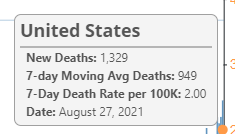
The CDC also maintains a useful dataset for Deaths over time. Unlike the Hospitalizations data (at the time of writing), this chart requires you to choose a Right Axis of Deaths per 100K people over the prior 7 days, since by default it just shows the counts (which while representative of the deep loss of a life and family, aren’t useful for comparisons of different things we have come to accept as “part of life”).

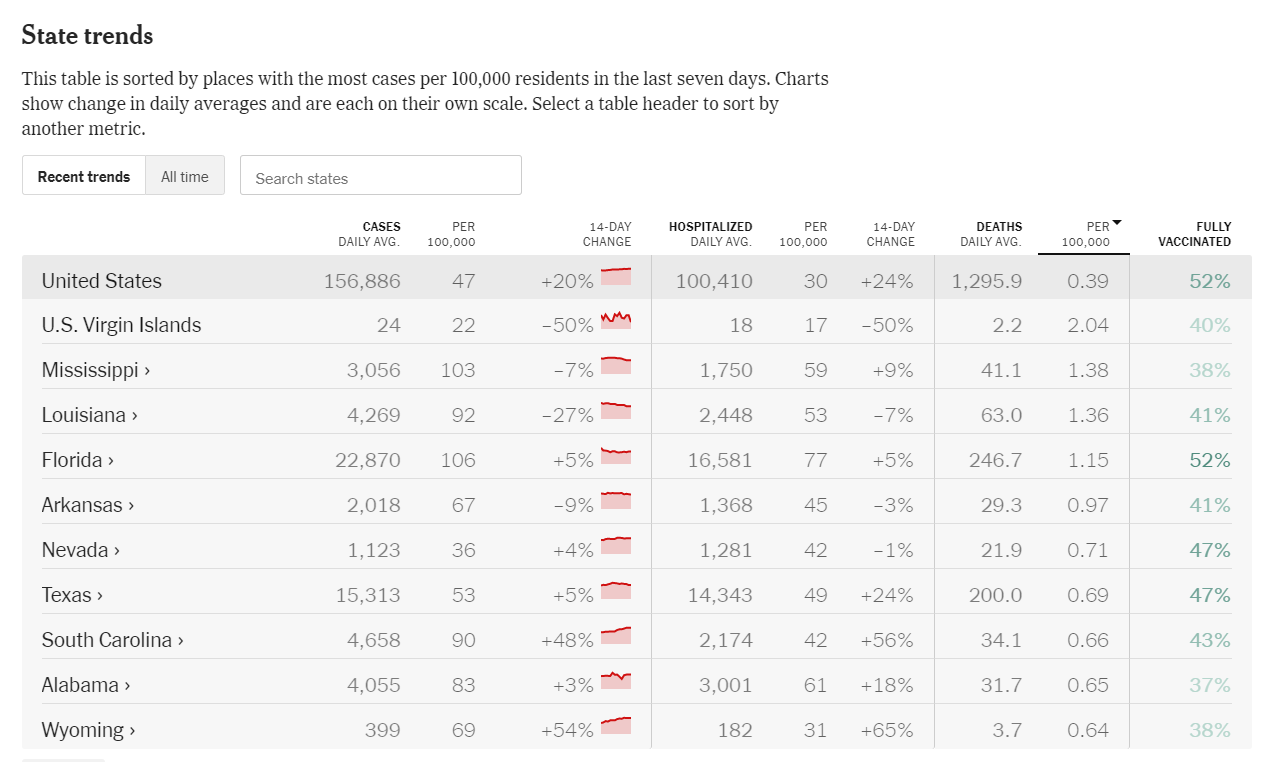
The CDC data allows you to chart up to 6 different regions, but if you want to look at a larger table, a good collation of tabular data is the NY Times COVID Tracker at who at the time of writing have a breakdown under “State trends” with cases over the last 7 days or by all time.

By clicking the row heading for State trends, you can order by Deaths per 100K people over a 7 day period:

Similarly to Hospitalization data, while this number is changing a lot, and varies significantly by location (because of uneven vaccination rates) and even more by age group, knowing what this number is provides a basis of comparison to other things.

The CDC also provides some lagging data showing the Weekly Deaths per 100K broken down by age group.

Comparison: Influenza

The most effective comparison – in my opinion – is another regularly mutating virus, spread through the air by people, which has also caused pandemics in the past: influenza.

For the last full year before COVID-19, the CDC produces an estimate of the number of hospitalizations and deaths from Influenza in a detailed report for the 2018-19 United States Influenza season.

Under Table 2 you’ll see Hospitalizations and Mortality (deaths) per 100K broken out by age.

Because this data is only broken out by age group, if we want to have a general comparison, we need to use Table 1 for the “All ages” datapoints. Note in the table below I’ve removed estimated infections and doctor visits since they aren’t part of my comparative set of how scary COVID-19 is.

For the 12 month period of 2018-19, the US population was 328.2 million (US Census Bureau).

Since the Influenza data is for an entire season (year), and many of the reports of a highly dynamic pandemic use a trailing 7 day average calculation, we need to try and change the yearly number of a weekly number by dividing by 52. This isn’t truly accurate (most influenza hospitalizations and deaths in the US happen in the winter), but it helps to convert a yearly number to a weekly number for comparison purposes.

TotalPer 100KWeekly Per 100K
Hospitalizations490,561149.472.874
Deaths34,15710.410.200

The key comparative insight is that only weekly COVID Hospitalization rates above 3 and COVID Death rates above 0.2 per 100K people are worse that Influenza.

One other interesting comparison is the age-based Per 100K Hospitalization and Death rates. Using Table 2 Data (which is already Per 100K calculated), converting the Yearly total to a Weekly number shows the following:

Age
group
COVID-19
Hospitalization
Influenza
Hospitalization
What’s
Worse?
COVID
Deaths
Influenza
Deaths
What’s
Worse?
0-4 yrs0.44*2.46Flu 5.5x0.02*0.025Equal
5-17 yrs0.44*0.75Flu 1.7x0.01*0.008Equal
18-49 yrs1.37-3.87*0.93COVID 1.5x-4.3x0.05-0.31*0.035COVID 0.7x-8.9x
50-64 yrs5.13-6.04*2.98COVID 1.7x-2x0.620.173COVID
3.6x
65+ yrs8.6610.2Flu 1.2x1.12-3.08*0.937COVID
1.2x-3.3x
* Ages Not Broken Out Equally by CDC COVID Data and Influenza Data

Importantly, the COVID-19 data is incredibly dynamic – I’m using mid-August weekly rates but a better approach would be to use a longer time period (since the numbers for young people in particular bounce between 0 and 0.05, which makes for a different result). However, even using these point-in-time dynamic numbers, it is worth noting that COVID-19 is only 1-2x as likely to put you in hospital as Influenza but it is between 1x and 9x as likely to kill you (with the highest relative impact being for middle-aged folks at this point in time).

At the time of writing,

Comparison: Road Accidents

Another effective comparison which comes from the “risks of living life” is Road Accidents. This national data in the United States is maintained by the National Highway Transportation Safety Board (2019 Report). There aren’t good reports for “hospitalizations” but instead “injuries” are tracked which is likely to over-count our comparison with COVID-19 since at least some road accidents are not going to require a trip to the hospital.

TotalPer 100KWeekly Per 100K
Injuries2.74M834.8616.055
Deaths36,83511.220.216
Source: NHTSB 2019 and Traffic Facility Data

The key comparative insight is that only weekly COVID Hospitalization rates above 16 and COVID Death rates above 0.22 per 100K people are worse than the risk of dricing in a car on any given day.

As of writing, in almost every State and Territory in the US you’re more likely to be Hospitalized for COVID than being injured in a road accident (Florida is worst at 76, and only UT, MD, CO, NY, MI, MN, NJ, RI, CT, MN, NH, MA and VT are below 16), with the national average at 30.

Conclusion

Interestingly – and coincidentally – the risks of dying from Influenza or in a Road Accident are almost the same (0.2 for Flu vs 0.216 for the Roads). You’re 5.6x as likely to be injured in a road accident than be hospitalized for Influenza, so to get a good grip on how scared to be of COVID is helps to focus on mortality rates.

The national risk of dying of COVID-19 right now is about twice that of dying of influenza or getting killed in a car accident (0.41 vs 0.22 per 100K), but in 19 states you’re actually at lower risk today (MI, UT, IW, ND, WI, NJ, MD, RI, SD, PA, CO, NH, OH, NY, NE, VT, MA, MN, CT and MN).

That said, in the worst affected places you’re way more likely to die of COVID than from Influenza or in a Road Accident, such as:

  • Mississippi: 1.51 per 100K or 7x more likely
  • Florida: 1.22 per 100K or 5.6x more likely
  • Louisiana: 1.17 per 100K or 5.4x more likely
  • Arkansas: 0.98 per 100K or 4.54x more likely

So, if you’re living in a place with a death rate above the chances of catching the flu or going for a drive, you should be scared of COVID. However, if you’re not, then you probably should chill out a bit unless you’re going to avoid humans and roads forever.

Image Credit: “COVID-19 in Washington DC” by dmbosstone is licensed under CC BY-NC-ND 2.0

America’s Greece(s)

In summing up the situation in Europe, the APM’s Marketplace show today made an interesting point: while the US and the EU both have a Monetary union, only the US has a Fiscal union – in short, the Federal Govt in the US raises taxes from all over the country, and then distributes them in ways that involves a transfer of income from one state to another.

It got me wondering – which states are America’s Greece(s)? While the situation with Puerto Rico is in the news right now because of their unsustainable debt burden (making them more like Greece to be fair), I got to thinking – which states are “givers” and which states are “takers” on an income and expense perspective.

To answer this question there is a great Wikipedia page which lays out the data from the IRS against the data of US Federal Government spending by State.

The problem was, the data dealt in raw numbers of millions taxed and spent, and while it also included ratios based on Gross State Product (GSP), but I was really interested in the per-capita net tax or subsidy state by state. So, combining the data from a few of these sources, I put together the per-capita numbers.

The results were really interesting, including:

  • The average person in North Dakota has the most amount spent per person ($77,040) by the Federal Govt. I don’t know whether this is farm subsidies (I’m told their crop insurance pays out even if they don’t bother planting), or if it is the result of a lot of money spent manning missile silos, but either way it is pretty breathtaking. Their fairly small revenue per person means each human in North Dakota costs the rest of America $66,782 per year (on average).
  • The average person in Utah has the least amount spent per person ($4,573) by the Federal Govt. That’s pretty impressive, and they’re followed not so far behind by Kansas and Nevada – so when those voters in these red states vote Republican and claim they want small government, they’re not being hypocritical.
  • Washington DC has the highest per-capita paid per person ($40,117), and the second highest spending per person ($40,296). This makes sense since there isn’t a “state” in the middle taxing or spending, but it is interesting the folks who write the rules pay themselves well out (often out of the Federal budget) and manage to get back just a little more than they spend.
  • The Carolina’s are very different fiscally – while they’re southern neighbors, North Carolina is a net contributor ($1,260 per person per year) whereas South Carolina is the second biggest taker from everyone else in America with a net receipt of $10,518 per person per year.
  • When it comes to Federal tax receipts, the poorest state in the Union is Mississippi ($3,678 per person), followed by West Virginia ($3,721 per person), with New Mexico ($4,199) the only state in the top 5 not from “the South” (#4 is South Carolina at $4,603 and #5 is Alabama at $4,906).
  • Former manufacturing-heavy states with “Rust Belt” populations make up a third of the top 9 biggest deficit states (#4 Indiana, #7 Wisconsin and #8 Pennsylvania).

While the climate isn’t nearly as nice, there’s a serious shortage of islands and no sea, without these heavy fiscal transfers, North Dakota would be America’s Greece.

fargo


Got other observations from the data? Would love to read them in the comments!

Cutting your Comcast Bill in Half – Part 1, Internet

Introduction

Comcast’s business model is simple – sell to new customers on a good deal and then rely on their laziness and ignorance to increase average revenue per account to thousands of dollars a year. Over the last month I’ve upgraded the internet at my house, my office and my girlfriends house and saved up to 50% while getting up to 6x faster speeds.

In this blog post I’m going to show you how to do the same.

Loyal Customers Get Screwed

The first thing – and this is the most important thing – to understand is that loyalty is actually punished by companies like Comcast. When you’re an existing customer, a whole slew of plans and options just flat out aren’t available to you – as the South Park creators so successfully showed, when you’re an existing customer, you’re completely taken for granted (or, “their bitch”, thanks South Park).

https://www.youtube.com/watch?v=M0sAVtOt2wA

The good news is, though, that you can overcome a lot of these problems just by being disloyal.

Saving on Internet

Before starting this process a month ago, the three specific monthly bills with Comcast were around $100 including taxes.

Initially, I followed the great advice of people like GE Miller and went through the “account retention” process – where you say you’re going to cancel your account and get immediately escalated to the Account Retention team. These are the people at the carrier who are rewarded and compensated for keeping subscribers, and who have a lot of latitude in what they are able to “include” or discount to keep you as a customer.

The rewards and bonuses must be pretty good, because some of them get pretty crazy.

While this is solid advice, there are still limits to what these people can and will do, and often their lowest price and best upgrade offer is still a much worse deal than you can get if you’re not a customer at all.

The solution, it turns out, is actually pretty simple. You become not a customer. Here’s the four-step process (with a bonus Step 5 to save another $500 a year).

Step 1: Choose a Plan

Providers are always running specials and deals to get new customers on board. I’m not sure what their Customer Acquisition Cost is (CAC) but given the number of advertisements I see it has to be in the realm of $500-$1000. For DirectTV, Selling, General & Administative costs make up more than 50% of its gross profit a few years ago – this is a lot of money.

This also makes business sense; they know through cohort analysis that if they can tempt you in with a good deal they’ll jack up the price and your laziness will keep you where you are.

Since I’m in America, the land of the free market and competition, there is almost no competition in broadband internet access. Being in San Francisco, that means I’m limited to looking at options with Comcast. At the time of writing, they were offering a 105Mbs internet plan for $44.95/month; the options change all the time though, so check out http://www.comcast.com/xfinity-internet-offers and decide on which plan suits you best.

When you look at the terms and conditions of the offer, you’ll note that one of the first conditions is that it is “available for new residential customers only”. That’s cool – you’re about to become a new customer, with some temporary help from a buddy.

Step 2: Enlist a buddy for an hour

Now you know what plan you want, it is time to start the process of becoming a new customer by getting some help from a buddy – it should only take an hour of their time, and you can actually return the favor for them if they want to do it at the same time!

The key is that your buddy is going to be signing up to the new internet plan at your house. They don’t need to live there – there’s no need for proof that they have anything at all to do with your address; all they need is some photo ID and a social security number.

To make it happen, you and your buddy simply show up at your local service center (Comcast ones listed here), and tell them that you’d like to cancel your service. Your buddy, standing next to you, would like to sign up for the “available for new residential customers only” plan you selected in Step 1 above.

You’ll want to bring your cable equipment with you, but you can hold onto it for a couple of weeks if you like (since you’re going to be coming back to do the same process in reverse in Step 3).

There is normally an account setup cost of $30, but if you ask them for a discount they’ll drop it down to $12 without a fight at all.

If you need a modem (and you should really buy your own – see further down this post) they’ll give you one on the spot. You’ll then be able to go home and plug it in (swapping out the one you already have) and once you go through a quick setup process (their phone number, 1-855-OK-BEGIN, works pretty well – just don’t do it on speaker phone because if the computer mishears you you’ll go into a never ending loop) and you’ll be online with your new faster cheaper plan in no time at all.

Step 3: (ab)Use The 30-Day Money Back Guarantee

Now, perhaps your buddy is a housemate or a significant other – if they’re happy to be the one with their name on the bill for the next 12 months then you can probably skip this step. However if they’re genuinely just a buddy doing you a favor who doesn’t want to run the risk that you won’t pay your cable bill and their credit report will be on the hook (or that you’re going to do illegal things online and get them in trouble as the legal account holder), you’ll want to do the process involved in Step 2 in reverse.

The good news is that Comcast has a 30-day money back guarantee, so you can head in after a couple of weeks and have your buddy cancel the service you set up in Step 2. They bring the cable box you got in Step 2 in and they’re done in about 20 minutes.

You, standing next to them, decide you want to become a new customer on the same plan. You sign up for the new plan/service at your own address, and you’re back in business, possibly for half the price.

Step 4: Set a reminder for next year

Most of the plans I’ve seen revert to their “normal” price after 12 months. So, you’ll want to set a reminder to go through this process again in a year.

Step 5: Buy your own cable modem

Comcast are currently charging you $10 per month to rent a cable modem (or wireless router). This comes to $120 a year, or almost $500 for the normal life of a piece of technology like this.

The good news is that you can buy your own from Amazon for around $60 if you don’t need wireless, or $100 if you do, which means you’ll be ahead in financial terms in as little as 6 months.

Savings

Now, some of you reading this will be thinking “hey, my time is valuable – is this really worthwhile?” You’d be right to think this way, but let’s look at specific savings and see how wrong you probably are.

Comcast Business to Xfinity Internet Plus Blast

Until this week we had Comcast Business at my startup. We’re not demanding enough yet to need WebPass or MonkeyBrains, and we were paying $84/month for 16Mbs.

In terms of changing plans, I didn’t even need “a buddy” because Comcast Business and Xfinity are very separate organizations inside Comcast. I simply walked into the Comcast customer service center and signed up for a new Xfinity plan as a new customer, came back to the office, and I was up and running – from walking out the office door to getting back and online – in under 60 minutes with 100Mbs internet for $45/month.

That’s a saving of $500/year – not bad for an hour’s work. If you’re legitimately earning more than $500/hour for every hour you work every week of the year (sure you are), then you might not get cash value in savings, but you’ll also see time savings by having your internet more than 6x faster.

Comcast Speed Test 1

Xfinity for Cable and AT&T for Internet

My girlfriend was running Comcast for TV and Xfinity for internet, due in large part because her apartment building told her she had to use AT&T (or another DSL service?) for internet access. Her total bill was over $100/month. I thought the instructions about using only DSL were a bit off because she was using Comcast for TV, and sure enough, it was possible to move her over to Comcast. Because she was an existing customer, however, she was stuck with paying over $100 to bring it all together – not a great result.

Through making the change to Xfinity for internet and cable box, she’s now paying $39/month. There’s still some frustrations with stepping back to non-HD cable, but we’re working on fixing that (I’ll have an update in a part two post about TV specifically).

So, while it isn’t apples for apples, she’s now paying $50 (when you include Netflix and Hulu) for basic cable, HBO and stacks of other streaming all through a super cheap Chromecast in high quality – a saving of 50% for internet 10x faster internet and all the content you can stream.

Wollongong’s Wonderful Renewal

TL;DR: my hometown has been a depressed and despairing place for all my life, yet on my most recent visit I was struck – truly struck – how much the city has changed for the better. It was breathtaking. This post is a reflection on my hometown’s history over the last three and a half decades (to get a sense of how far we fell behind) and some observations about what’s really working to turn the place around, creating an incredibly bright future.

Opening celebrations for the new Wollongong Central project. Photo: Robert Peet, Illawarra Mercury

The centre of Wollongong coming back to life. Photo: Robert Peet, Illawarra Mercury

Update: looks like this post has touched a chord – more info on the response in this separate post.

I’m writing this on a layover in Auckland flying back to San Francisco from one of my quarterly trips to Wollongong, my home town, located an hour south of Sydney. With more than half of the AffinityLive team based in our Wollongong engineering office, I make sure to get back to spend quality time with the team every few months – especially given the growth in our Australian team (up 150% in the last year).

Returning to visit my home town every few months – spending time with mum and staying in the house where I grew up – has given me a really interesting perspective to observe the changes happening in Wollongong. Like when you catch up with distant family members or friends with kids only occasionally, being an infrequent observer helps you see starkly the changes every-day observers see only gradually. Unlike kids who are “getting so big” and “growing up so fast”, a city can be getting noticeably better, or worse.

Noticing changes in our hometowns when we return isn’t anything unique or unusual of course – it happens to any of us who’ve moved away when we come back for a visit. When I notice the changes in Wollongong, though, I’m looking with more than the usual sense of nostalgia.

A Decade of Regional Development Efforts

For more than 10 years, through my early 20’s to early 30’s, I was involved in civic activities to try and make the city a bit less dark, dreary and depressing. On the civic front, this included being a foundation board member at RDA Illawarra (like a regional council/county) and a board member of the Wollongong Hawks (our national basketball league team). On a professional/technology front, this included co-founding (if that’s the right word) initiatives like StartPad (precursor to iAccelerate), ICTI and Digital Wollongong. All told, I’m guessing I spent around 2500-3000 hours working voluntarily to improve the prospects for employment, liveability, and the economy of Wollongong.

Like many hard(er) working champions of Wollongong, I toiled away because I believed in the potential of the city: the incredible human capital in the thousands of smart, educated people graduating from the University of Wollongong, the amazing natural environment with our mountains and beaches, and our close proximity to Sydney (and all that this overpriced, congested, global city offers).

But, while it was rarely discussed among those of us championing the city, I also knew deep down how dark and depressing the situation in the city was. Staying upbeat and positive in the face of a depressing reality is OK in short bursts, but trying to keep it up indefinitely will send anyone crazy eventually. And there were a lot of us showing crazy cracks.

Structural Suffering & Depression

Born in the last 100 days of the 1970’s, I’d never known my home town to be prosperous or successful.

As a city dependent on steel manufacturing and coal mining, the 80’s were particularly brutal to Wollongong. Technology and international competition reduced the steelmaking workforce by 80% (from almost 29,000 employees in the late 1970’s to 6,000 in 1996). By the middle of the 1980’s, a collapse in the price of coal meant the higher-cost underground coal mining industry couldn’t extract coal profitably competing with cheaper open-cut methods, causing numerous mines to completely close.

hard-coking-coal-real-price

The knock-on effects outside these direct employers – transport, maintenance, equipment etc – were massive hits on a region with a population of 200,000 people. Port Kembla, once a bustling town, effectively died (except for the prostitution).

When I was studying economics in high school, Wollongong’s unemployment rate was 5 percentage points higher than the national rate, and things were much worse for young people. Many of the “blue collar” jobs our newly retrenched locals had the skills to fill didn’t exist in the country, much less the city.

Social Disadvantage and Despair

In addition to this “structural unemployment” caused by major industry decline, the other big challenge was/is the massive-scale “social housing” developments (in the US they’re called “projects”) built in the north and south of the city in the 1950’s. The consequence is that the city has tens of thousands of disadvantaged people, many of whom didn’t count in the unemployment statistics because they didn’t bother looking for work (either because they believed it wasn’t out there or they were content to eek out an existence on welfare payments and/or less legitimate means). Not looking for work means a lower “labour force participation rate” – Wollongong residents were 15% more likely to be part of this “hidden unemployed” than the Australian average (Wollongong at 56.2%; Australia at 64.6%).

If the fifteen years to the middle of the 90’s were tough, things didn’t get better with the boom Australia experienced over the next decade: instead of catching up from a rough period, Wollongong fell even further behind. From 1996 to 2006, job growth in the Wollongong area was barely half that of the rest of Australia (Youth Unemployment in Australia, Burrows, 2009, page 5).

In summary, you had a place that had been mauled by structural change, had a much greater than average number of people who’d “dropped out” of the economy (at least) – a pretty poor situation to then get hit with “the recession we had to have” in the early 90’s.

If this wasn’t bad enough, when things turned good with the longest expansion since WWII for the rest of the country, Wollongong was instead just slowly staggering forward, creating jobs at half the rate of the rest of the country.

Dark Clouds & Self Delusion

The collective effect of all of this was an often dark, despairing cloud hanging over the spirit of the city. That the only “feel good” leader of the city I can remember was later found to be a paedophile (and murdered “Primal Fear” style) is as damning as it sounds. Other leaders like my friend David Campbell mainly tried to minimize harm and manage the situation, while many other “leaders” who were just in it for themselves and their crooked mates held the city back. Given the politics of the region (very safe seat requiring no electoral benefit for any government to give a shit about), even if there was a credible government turnaround plan based on leadership and investment, there wasn’t the political willingness to fund it, much less leadership to lead it.

While the city still had all of its natural beauty, you could see why Wollongong was sneered at and looked down upon by most other Australians.

Efforts to change perceptions, while well meaning, stood no real chance of lasting success because they projected fiction, not reality (locals will remember the “Image Campaign” and the ‘we all know it’s bullshit’ tagline “City of Innovation”).

To illustrate, imagine the experience of a visitor who’d caught the train to Wollongong; they’d have to navigate crowds of bogans, junkies and petty crims, run the gauntlet of western Crown St and the dark and violent mall (see video below), pass the eyesore of the entertainment centre, to finally make it to the beauty of the beach and Flagstaff Hill.

https://www.youtube.com/watch?v=R4RO0m_AvL4

Don Draper couldn’t market our way out of that reality. The fact we tried is testament to our tenacity and belief in the potential of the city.

First Signs of Promise

I remember being involved in a project in 2006 called the “Wollongong City Centre Revitalization Strategy“. It was spearheaded by the state Department of Planning under Frank Sartor, and a special agency was set up, headed by the impressive and energetic Chris Johnson to develop plans for half a dozen cities in the state. Wollongong was the first to get the treatment (probably because it needed it most), and I was one of the committee members providing input and reviewing the ideas/research coming out of the Department of Planning and the Office of the Government Architect.

For as long as I could remember, ideas to improve the city’s situation were vested in “projects”, most of which were little more than thought bubbles. There was the project to install a gondola, Cairns-style, to the top of Mt Keira to boost tourism. There was the project to build a boardwalk, Atlantic-City-style into the Pacific ocean off City Beach. There were innumerable individual property development projects, all of which needed to get a planning exception approved by Council because the City’s land-use plan was a few decades out of date and anything of any significance height or size wise was impermissible. Some of the projects worked out well – Innovation Campus – and others were massive mistakes that will rob the city of potential for generations (building the windowless Entertainment centre and rebuilding a barely used Stadium on prime beach-front land are right up there).

The City Centre Revitalization plan was different. Rather than focus on a specific issue (or two), it identified a series of a dozen that the city could do to revitalize the city centre. The plan applied research and best practices from around the world (Wollongong certainly wasn’t the first city to find itself in a depressive downward spiral). Some of them were needlessly controversial (build higher density and really tall buildings around transport infrastructure like the station – oh no, tall buildings must be evil!?!). Some of them were more aspirational, and others were just common sense (yet the fact they still had many detractors showed how there is an inverse correlation between the spare time some people have to complain and their actual levels of common sense).

wollongong-city-vision-concept

The strange thing about the process was just how obvious and sensible the whole thing was: identify the problems, create a series of complementary visions to address them, and then change planning controls and policies to encourage them. Some inspired decisions by government (the free Green Bus) played their part, but on the whole it was about setting the system up (with better, modern rules and incentives) so the economic energy of the private sector could turn high level visions into concrete reality. The community’s role in helping shape the plan was at the planning stage, not the implementation stage – instead of arguing about building X or traffic change Y, the high-level blueprint right at the beginning was the focus of input. Of course, community participation was fairly poor (less than 1% of the city’s population made a submissions), but from what I’m told by people who do this sort of consultation for a living, the website we built and the town-hall meetings we held resulted in about 5x the normal amount of participation than this sort of thing normally gets.

The main pieces of the vision, after debate and dilution (opening the mall to slow moving traffic outside core shopping hours and bonus building height (or FSR) rules for buildings subject to design competitions being the two I most regret seeing sidelined), the rules were codified as a new Local Environment Plan (LEP – the legal document that outlines what can and can’t be built by “zone”) by early 2007. The stage was set, but then things appeared to make a big turn for the worst.

Darkest Before the Dawn

As they say, if you want things to change, you’ve got to change things. However, changing things on a city scale is a pretty capital intensive undertaking. Building new buildings, upgrading transport, roadworks and other cityscape improvements aren’t cheap, fast or easy. With most of the things needing to change in the city being privately owned property, it also wasn’t something you could mandate top-down – the private sector needs to want to change, want to invest.

All of this was going to be tough, a long game. Then two things happened – the city became embroiled in its largest ever corruption scandal (March 2008), and then not long after that the global financial crisis hit (Lehman Bros collapsed in September 2008, freezing credit markets globally).

The ICAC investigation into the corruption in the Wollongong planning and approvals department was dynamite – many locals knew of stories of corruption through shadowy networks that operated with such perceived impunity that they didn’t even bother trying to hide their behaviour, but to have secret recordings and explosive evidence that touched all three boxes of money, sex and power was a massive shock to even the most cynical resident.

From daily “table of knowledge” meeting in broad daylight outside a beachside “cafe”, to special assignments of project assessments to ensure the bad eggs could operate with official cover but no oversight, and then finally the dirty money and sex that bound the whole thing together, the whole thing was an epic and embarrassing drama carried extensively by the national media. The effect was to reinforce a reputation of the city as being full to the brim of the kind of sketchy, moronic mafioso that outsiders already associated the place with.

It felt like a body blow, and undid any achievements of the “image campaign” from outside the city. Trying to run a business with clients in Sydney and Canberra from Wollongong was nigh-on impossible – the entire city was tarred with the brush of these corrupt criminals.

Following the ICAC investigation, the city thankfully got the cleanout and fresh start it desperately needed from a governance and leadership perspective. All of the Councillors were sacked and replaced by administrators from outside the region. A new General Manager was appointed, and the newly instated rules around projects that came out of the City Centre Revitalization Strategy (and other improvements outside the city centre) gave the defined planning rules their first real upgrade in decades, clearing the path for a series of new projects not facilitated by case-by-case deal making.

On the economic front, changes in the costs of finance meant barely viable projects approved under the old regime (Belmorgan anyone?) started biting the dust before they’d done much more than acquire and consolidate land parcels.

The Great GPT Gamble

In an incredibly fortunate piece of great timing, the city’s largest property developer/operator, the listed GPT Property Group, had to make a decision about dramatically upgrading their shopping precinct in the city. One of the big hold-ups of such a decision – budgeted at $200 million – was whether competitive developments were going to spring up leading to an oversupply in large format retail and entertainment space – no one wants an expensive white elephant. With the looming financial crisis sinking competitive projects like the Dwyers site redevelopment, GPT had the balance sheet and access to funds to back the massive new Crown Central development.

In one of the most critical decisions for the city in many years, and with a freshly cleaned out council executive overseen by outsiders with a focus on pragmatism over parochial politics, the massive project to remake 15% of the city core in one go was approved by the GPT board in Melbourne in 2010. Two years after it had been approved by Council but put on ice by GPT because of the financial crisis, the project was now a go. The decision was even more brave given what happened 12 months later: the steelworks shut down its export business and lost another 1000 jobs.

At the time of GPTs decision (late 2010), it really wasn’t clear (in my mind at least) what the significance of the project to the city would be. With the move to online shopping, and regional centres with closer proximity to suburbs and easier parking getting $300 million dollar injections at the same time, focusing more of the city on retail seemed questionable at best. Thankfully though, GPT’s focus was as much on hospitality and entertainment as retail – a massive win for livability in the city.

When combined with the City tearing out of the disgraceful “bird cage”, the crapitheatre and a lot of the seating in the old mall (city tested, bogan/junkie approved) these two parts of the vision from 2005 have come together to dramatically reshape the city.

Similarly, a number of residential projects – with ground-level retail/restaurant activation – have taken advantage of the new “baked in” development rights from the 2006 vision’s upgrade to the planning codes has created a boom in inner-city residential development; today we see thousands of people actually living in the city core, giving it life after dark, a trend that shows no sign of slowing down.

Of course, both projects have taken their time, and it is only now in 2015 that the dividends are really paying off. These dividends – more competition, more choices, more quality, more food/cafes, less straight retail – are self-evident for anyone, but it is the change in the city culture and vibe that has the most appeal and makes me most excited.

More Buskers & Baristas and Less Bogans

By the start of 2015, the transformation was clear for anyone to see, and it was awesome.

From a practical point of view, the addition of Coles to the city centre has made it much more convenient to get stuff for the office or wander over at lunch time to grab some groceries for dinner – working in the city centre is now really really desirable.

But while utilities like Coles and Target help with convenience, it is the proliferation of places to eat and drink (combined with the new small-bar laws creating establishments you can go to without a real fear of being punched or glassed by an aggressive bogan) that has really made the difference.

The city centre is now a place you want to be.

On Thursday night I walked through the western end of the mall, and you could have knocked me over with a feather. A dozen or more of the city’s better restaurants had shown up and created pop-up take away dining experiences – for my American friends, imagine food trucks without the need for big trucks. The city was absolutely buzzing, with a singer-guitarist putting on a show, and in other parts of the mall there were other talented buskers doing their thing. The experience repeated (with differences in vendors) on Friday with the popular farmer’s markets through the mall. Walking through the stores was great too: there were plenty of shoppers; the place was packed. People were smiling and enjoying being together with strangers in a public space.

The differences to a similar shopping experience from a few years earlier couldn’t have been more stark. On a normal Thursday night at 7pm, the mall would be full of hood-rats who’d come in on the train as packs and acting like wannabe-gangbangers, sitting around, leering and screaming at each other across the mall. No one was happy – it was the depression and darkness of the city’s psyche manifest in hundreds of bogans and junkies just existing. Early in the evening they generally kept to themselves, but by 10pm the mall became a fairly dangerous place to be, with numerous bashings occurring almost every weekend (see video above).

The best thing about the changes in the centre of the city over the last few years is the effect it has had on social norms. Now there’s more buskers, baristas and cocktail barmen in the city centre than bogans yelling “fark off ya caaaant” while they suck back another pack of Winfield Blues. This doesn’t mean the city isn’t open, welcome and inclusive – it just means that expectations of behaviour and a default attitude is now a positive, aspirational and friendly one rather than a dark dog-eat-dog mindset of the depressed and despondent.

A sense of community has returned – and it is wonderful.

The Reinforcing Loop

The great thing about this amazing transformation is that is creates a positive feedback loop. With the city centre being enjoyable (for the first time in my life at least), people who visit will visit more often. They’ll look to rent or buy apartments in the city (rather than fearing the occasional necessary visit), and spend even more time in the city.

With more regular people enjoying the city each day/week, the social attitude of the city is changing. Bogans become just another part of the city’s colourful tapestry rather than the dominant negative force dragging the place down and scaring other people away.

People want to be in Wollongong, which brings more people who aren’t in the depressed and disadvantaged category, which normalises the mix of the city and lifts the experience for everyone (including the bogans, and more importantly their kids who stand a better chance of breaking the intergenerational welfare/poverty cycle if they see things and people they’d like to emulate).

This means as more people visit or move to the city (and the University brings in over 10,000 new non-bogan people every year) and really, truly enjoy being there, they stay and bring their friends in too. Instead of an “Image Campaign” telling stories of barely evident aspirations through an inadequate marketing budget, the city starts marketing itself through the tens of thousands of people who now truly do love the place.

With these people come the opportunities for more jobs and higher incomes in the city. Attempts to bring in outside employers to create jobs were usually doomed to fail by the fact that no-one from outside Wollongong really wanted to move here, something that is rapidly being solved. Additionally, a vibrant and enjoyable city means more young people graduating university are likely to hang around and try to create their own jobs through entrepreneurial ventures – Wollongong’s lower cost of living, proximity to Sydney Airport and plentiful supply of smart people coming out of the University makes it a very legitimate place to start a global venture – AffinityLive is testament to that.

While only a small and anecdotal statistic, more than half of our new hires this year are people who want to come back to Wollongong from Sydney or Melbourne – not because they have a sense of obligation to be close to aging family members, but because life in all its dimensions is so much better than dealing with Sydney’s “let’s stop trying to make the city better now the Olympics is over” traffic and transport disasters.

For the first time in my life, my home town is actually on the front foot and you can feel the city is finally on track to realize its incredible potential.

The Future

Thinking about the future, the main thing is to keep doing more of the same. This means more buildings and development, particularly in the city centre, with higher densities and heights so new housing supply is as affordable as possible and ensures these new investments in making the city livable – which depend on shoppers, diners and guests to succeed financially – have the number of patrons they need to flourish.

Similarly, the success of the Wollongong city core can and should be replicated across other regional cities. Thirroul, Corrimal, Figtree, Dapto and Port Kembla would do well to follow the lead of Wollongong City: setting clear, generous rules around building heights and densities to encourage more people to actually live, rather than occasionally shop, in them.

There’s also a number of parts of the city that have been left out of the revitalization so far, rotting and decaying. The prime example that comes to mind is Wollongong Harbour. With its sorry and barely-used fishing fleet, asbestos filled shed on the central pier, this generally under-used and under-loved focal point of the city has a lot of potential. Some work that I was involved in in 2009 outlined some ideas about unlocking the potential of this amazing space, included in the Wollongong Harbour Consultative Committee Report – it would be awesome to see the same renewal we’ve seen in the city centre happen here.

Of course, encouraging building and residential development is all well and good, but people still need to be able to find and keep quality jobs.

Part of this will come organically as the city continues to be more desirable as a place to live, visit and thus work and companies come to the city because of the talented people here, not because of a supply of cheap, unskilled and unemployed labour.

Another part of it will happen through startups and entrepreneurial effort creating new opportunities from the city, for its residents, with customers predominantly from outside the region – hooking onto the success stories we have and investing in the next wave of entrepreneurs will also be critical to success.

Conclusion

The city has a long way to go to realize its potential, but the most exciting thing is that it seems well on the way to achieving it, underpinned by strong fundamentals of strong human capital and a great living environment (in both the built and natural form).

If we can just keep this momentum going and rightly celebrate our successes so far, this current phase of “the brightest the city has ever been” will be a phase we look back on and smile as only the beginning.

UOW Occasional Address – It's what you do with it that counts

Introduction

Today is one of the days you’ll remember for the rest of your life.

It might be because you feel proud – it is the culmination of thousands of hours work and study.

It might be because you feel relieved – no more cramming for exams and assignments at the last minute.

It might be because you feel dominant – after countless hours of swearing and rage you’ve managed to beat the compiler and debugger enough to graduate!

It might be because you feel appreciative – for the amount of support you’ve received from teachers, parents and friends over many years, efforts that you might not have appreciated at the time when you were stressed about an exam or an assignment.

It is probably all of these reasons, and more – this is a special day for you all (and sometimes more so for the parents and friends up the back).

Given this is such a special day, when you get a call from the VC and you’re asked to give the Occasional Address, you naturally want to make it to be good.

You think back to the great addresses given at occasions like this by people like Steve Jobs, Theodore Roosevelt and Nelson Mandela.

You naturally think, “Hey, I should try and impart some wisdom and amazing advice,” and then you realize there’s a little problem.

I’m less than 10 years older than the average age of the graduands here. I don’t have enough grey hair yet to have any wisdom to impart.

It gets worse though. I’m an Informatics drop out. I’m never got to sit in your seat as an Informatics graduate.

What legitimacy do I have to fill you full of advice about what to do now you’ve graduated?

Damn, so we’ve got a bit of a problem.

So, rather than vainly try and fill you with wisdom I don’t have, coming from a drop-out without legitimacy, I thought instead it might be more valuable for you to share a few stories and lessons learned, and then I want to do something a little unorthodox – I want to throw thrown down a challenge to each and every one of you.

That’s right. A challenge.

If you only take away one thing from my talk today, I want you to remember this: it isn’t where you’ve been, what you’d done or what you’ve got: it’s what you do with it that counts.

What I want to do today is challenge you in what you do with what you’ve got. I’ve got three stories to share with you today – one that might help see how to work with what you’ve got, one about the perspective you should have, and one that is about why you should do it, rather than talk about it.

Find something you want to work hard, be passionate and get better at

As I mentioned before, I’m a drop out. It was early 2000, and the whole world was crazy. The internet was changing everything, or so they said. I’d been dabbling as a freelance web developer to make some extra money to spend on beer, back in the days when that meant writing code first, and making things pretty and usable second. The minority of Australian households with internet connections all used modems, and frankly, the quality of web design sucked.

So, in early 2000, I dropped out of uni, quit my job at the Novotel, and moved out of home, all in the course of a couple of months. I registered my company, Internetrix on the 10th of April 2000, and within a week, the Nasdaq crashed.

The dot com bubble burst, and I’d just staked my ability to survive on an industry that was just taken around the back of the shed and shot.

As you can imagine, this situation presented a few challenges. So how was I able to grow from Internetrix from a one-man-band into an award winning company, recognised as a partner by companies like Google, with clients in the US, Japan, China and of course here in Australia?

In short, there were three things – work hard, be passionate and never stand still.

Selling thousands of dollars of IT services to businesses when you’re a 20 year old with no track record is bloody hard. When they’re small businesses, it is harder. When they’re small businesses in Wollongong, it is almost impossible.

If keeping a fledgling business going wasn’t hard enough, the government introduced the GST when I was only 3 months in; I had to learn accounting and tax, and quickly, since I couldn’t afford an accountant.

And being young meant I was easy prey for bad actors – between being ripped off and having people threaten to sue me I had to learn quickly how to survive in the jungle.

It was frigging hard work, but thankfully I didn’t have the temptation of a cushy graduate position as an alternative of making it work.

This could have been because I wasn’t a graduate – I’d dropped out. But it wasn’t.

This could have been because the whole industry had just exploded and no one was hiring IT people, especially drop-outs with very little experience.

But it wasn’t.

I pushed through without the temptation to do anything else because I’d been bitten by the startup bug – the freedom and excitement of creating something out of nothing was just too intoxicating for any mere job to ever be enough after that.

I didn’t start Internetrix to get rich. I started Internetrix because I had a believed that the internet was indeed transformative.

I also believed that your average business they had been doing it wrong – they spent money on a website without knowing why, and how the investment was going to pay off.

From the beginning, had a passion for building a startup that helped clients get a positive return on their online investment – this passion put my business on a good footing, and I was able to develop long term relationships with clients that allowed my business to grow.

But this energy for hard work and passion to throw yourself at something isn’t enough – in our industry, you have to have a hunger to keep learning. Things change so incredibly fast. You need to be constantly reading, experimenting, learning, hacking and tinkering.

It is only by being at the top of your game that you can combine your willingness to work hard, with your passion for the field, and know when you stand in front of a client, a colleague and a new hire that you have what it takes. IT is a meritocracy, without the baggage of other professions, so you’ve always got to be willing and able to bring the best to any occasion. Cramming won’t do it. You need to be continually training, and if you’re working in a field that you don’t care about, that you’re not passionate enough to read about in your spare time, do something else.

So, what’s the lessons here? Since what matters from here is what you do with what you’ve got, make sure you’re prepared to work hard, be passionate and stop improving at what you’re doing. If you’re not, you should do something else.

Play on a World Stage

In mid January 2006 I found myself in the Hard Rock Casino in Las Vegas  as a guest of the owners of MySpace, which at the time being was the world’s 4th most trafficked web property. Later that week I was pitching to the world’s most respected venture capital firms, the people who’d make the initial investments in Google, Yahoo, EA, Facebook and many other household names.

I spent three months living at the home of Mike Arrington, the founder and editor of Techcrunch.

This all happened because I co-founded a company, Omnidrive, with a fellow uni dropout, Nik Cubrilovic in mid 2005. If you’ve used Dropbox, you’ve got a good idea of what we were building – cloud based storage with clever sync technology between multiple devices. And while our business failed (and Dropbox just raised a round of capital on a $1B valuation), the crazy roller-coaster experience was one of the most valuable things I’ve ever done.

Thrust into the limelight of Silicon Valley and playing the startup game at the time Facebook was just getting going was an amazing experience, not for what I learned about business, fundraising or the industry, but because of what I learned about myself.

Driving down Highway 101 through the heart of Silicon Valley, you see the headquarters of companies like Oracle, Yahoo and Google. Seeing these buildings, and realizing they were real places, with real people working there, people just like you and I, was paradigm shifting.

When it comes to technology, Silicon Valley is unquestionably the top level the world stage. It is where the best in the world compete and define technology worldwide. One night I was lucky enough to have dinner with Marc Andreessen, the founder of Netscape, because a friend of a friend made an introduction and he was free and keen to find out about what we were doing. It is just that kind of place.

While initially feeling very inadequate and out of my depth, it didn’t take too many meetings with VCs, too many conversations with entrepreneurs at dinners and beers with senior engineers from places like Yahoo and Google at parties to start to realize that I had what it took to go toe to toe at this top tier game.

And it wasn’t anything special about me. I was an average student. To this day, my staff would ban me from all hacking and meddling if they could. And yet, as time went by, I got the sense I wasn’t out of my depth.

I thought about the dozens, if not hundreds of tech people I’d work closely with in Australia over the years, and realized that they could also hold themselves in this, the beating heart of technology globally, and could honestly regard themselves as being world class. The distance between Wollongong and San Francisco might be great, but the difference in calibre of technologist wasn’t nearly as great as I’d imagined.

The University of Wollongong has one of the best IT programs in Australia, and so what I’m saying is that you have what it takes to go toe to toe with the best in the world too.

Two UOW alumni who aren’t that far ahead of you – and one of whom was sitting unemployed on North Wollongong beach in January – have built a startup in the last 6  months. After going to Silicon Valley a couple of months ago, they are now in acquisition discussions with some of the biggest names in technology fighting over them.

These guys are just like you, and if they can do it, so can you. Why shouldn’t you be the next Steve Jobs, Bill Gates or Mark Zuckerberg? Seriously.

So, what’s the lesson here? When it comes to thinking about what you’re doing to do with what you’ve got, make sure you’re mindset is to be world class and play on the world stage.

Be the man in the arena

This last story is not my own, so it is probably the most important of three stories I’m going to tell today.

Theodore Roosevelt was the 26th President of the United States, and when he became President in 1901 at age 42, he was the youngest man ever to do so. Widely regarded as one of the best Presidents in US history, Teddy was invited to give a speech at an occasion like this at Sorbone University in Paris, one of the world’s oldest Universities, established in the 12th Century.

In his speech, he reflected on the temptation among the learned and privileged scholars and academics before him to become commentators, critics and cynics. He cautioned against this, and delivered some of the most stirring words I’ve ever read:

It is not the critic who counts; not the man who points out how the strong man stumbles, or where the doer of deeds could have done them better. The credit belongs to the man who is actually in the arena, whose face is marred by dust and sweat and blood; who strives valiantly; who errs, who comes short again and again, because there is no effort without error and shortcoming; but who does actually strive to do the deeds; who knows great enthusiasms, the great devotions; who spends himself in a worthy cause; who at the best knows in the end the triumph of high achievement, and who at the worst, if he fails, at least fails while daring greatly, so that his place shall never be with those cold and timid souls who neither know victory nor defeat.

There is little use for the being whose tepid soul knows nothing of great and generous emotion, of the high pride, the stern belief, the lofty enthusiasm, of the men who quell the storm and ride the thunder. Well for these men if they succeed; well also, though not so well, if they fail, given only that they have nobly ventured, and have put forth all their heart and strength.

When it comes to rising to the challenge of what we’re all going to do with our education, our skills, our lives, I believe this message is the most important. As President Roosevelt says elsewhere in this same speech, “To you and your kind much has been given, and from you much should be expected”.

As Informatics graduates, you have more power, more opportunity to change the world, than any other group in the history of mankind. I mean that. Think through history, and think about the forces that are going to drive, enable and facilitate the future of our world more than any others. Technology is common to all of them, for good or for evil.

Just take a moment and reflect – today, there are now more than a billion people online, and if you throw in mobile phones there are billions more.

We’ve seen how technology has changed the world in Egypt, Tunisia and other parts of the middle east in the last few months.

Closer to home, the opportunities to change healthcare, education, how we live, how we work, and more are vast. We’re only three or four decades into the information revolution – even if we accept the pace of change now is much faster, compared to previous revolutions – industrial, bronze, etc – we’re surely now in little more than the first early rays of a new dawn.

I believe we all have the power, the opportunity and the responsibility. But, to make a change, to make a difference, you have to be in the arena.

So, how can you get into the arena?

Of course, I have a natural bias towards seeing the arena as being a part of a startup. You put it all on the line, and even if you fail you still learn so much more than you would working for a bank or the government in a graduate role. There has never been a better time to do a technology startup – thanks to cloud services the costs of getting going are lower than they’ve ever been, and with a mature web audience of over a billion people, and app stores and the like making distribution and payments easier than ever before, I’d encourage all of you to keep the idea of doing a startup in the back of your mind.

But, being the man in the arena doesn’t just mean doing a startup. It can mean passionately advocating for change and improvement in a workplace. Or using your technology skills to help a cause you’re passionate about. Whatever you choose, the key is to both avoid the temptation to just throw rocks or criticism and cynicism from the stands, and show the courage to get down into the arena.

So, when answering the challenge of what are you going to do with what you’ve got, make sure whatever your doing, you’re doing it in the arena, for that’s the only place that matters.

Conclusion

From here, you’ll follow many different paths, across careers, across the world.

You should take this time to reflect and look back with pride on what you’ve achieved – enjoy this moment and the sense of achievement that rightly comes with it.

But also realize that from here, it isn’t what you’ve done to get here that matters – it is what you do with it that counts.

When it comes to choosing your challenge, work hard, be passionate and always keep getting better.

When it comes to framing your challenge, be world class and don’t be afraid to play on a world stage.

When it comes to how you tackle your challenge, remember to always be in the arena, fighting to succeed but not afraid to fail.

Good luck and I wish you all the best in rising to the challenge of doing something amazing with what you’ve got.

Wollongong is on a burning platform

Over the last couple of years, I’ve been getting increasingly concerned about the future of our city. Leaving aside the rot exposed through the ICAC investigation, I’ve been mostly worried the future of the city from an economic perspective.

Are we going to be a place where our young people can build careers & families with confidence and a sense of optimistic opportunity?

Or are we going to increasingly be a hollowed out city, with a population that in large part commutes to Sydney for work, or lives off Centrelink, or comes here to to retire?

Are we going to be proud and strong, or are we going to be like Tasmania – a small backwater that everyone looks down upon and only survives because they suck in taxes paid by the rest of Australia living in large part off handouts?

My worries about the future of our city have grown even more acute over the last few months.

Our city has operated with a bit of a handicap in all 31 years I’ve lived here – the downsizing at the steelworks and in the broader manufacturing sector has been playing out since the 1970’s. But while we’ve stoically pushed forward over the years, I’m concerned that rather than just the disappointment of unfulfilled potential that we’ve learned to live with, we’re actually facing some very serious challenges that could threaten the viability of our city.

Our Two Fires – Carbon Pricing & Dutch Disease

In the short to medium term, there are two external forces, more than any others, that are affecting Australia’s entire economy.

The first is the transition to a carbon constrained economy, and while there might be debate around the details and timing of a carbon price, I think most people accept that reducing global dependence on carbon (ie, coal) as an energy source is inevitable.

The second, and much more important and threatening issue in my view, is Dutch Disease, the situation where a high currency value because of exports in one part of the economy – in our case, the mining/resources boom centred around WA – makes it almost impossible for exporters in other parts of the economy to compete.

While Carbon Pricing and Dutch Disease are having a negative economic impact in lots of communities around Australia, there are few, if any, that are threatened as much as our city and region.

In a message to all his staff earlier this year, new Nokia CEO Stephen Elop told a story that I think has strong parallels to the situation our city is currently facing:

There is a pertinent story about a man who was working on an oil platform in the North Sea. He woke up one night from a loud explosion, which suddenly set his entire oil platform on fire. In mere moments, he was surrounded by flames. Through the smoke and heat, he barely made his way out of the chaos to the platform’s edge. When he looked down over the edge, all he could see were the dark, cold, foreboding Atlantic waters.

As the fire approached him, the man had mere seconds to react. He could stand on the platform, and inevitably be consumed by the burning flames. Or, he could plunge 30 meters in to the freezing waters. The man was standing upon a “burning platform,” and he needed to make a choice.

He decided to jump. It was unexpected. In ordinary circumstances, the man would never consider plunging into icy waters. But these were not ordinary times – his platform was on fire. The man survived the fall and the waters. After he was rescued, he noted that a “burning platform” caused a radical change in his behaviour.

We too, are standing on a “burning platform,” and we must decide how we are going to change our behaviour.

I believe our city too is standing on a burning platform.

Examples of our industrial decline

Lets have a look at an example, in the form of Bluescope, the region’s largest employer and also responsible for tens of thousands of related and multiplied jobs.

Bluescipe recorded revenue of $4.75B in their Coated & Industrial Products Division (which is pretty much all of Port Kembla), down over 20% from over $6B in sales two years earlier (2008). And this is just sales – during this period, raw material costs went up, and the Australian dollar increased in value by more than 70% since late 2008. This exchange rate movement – the Dutch Disease in action – has made every person on payroll, every megawatt of electricity and other AUD expenses 72% higher now than their international competitors, assuming no increases in wages, power costs and the like.

Little wonder then that Bluescope experienced a drop in profit of 85% between 2008 and 2010 (and in the GFC and the 2nd half of 2009 they actually made sizable losses). While today’s announcement of an additional $300M in industry assistance for the steel sector (read Bluescope and OneSteel) will make some people in the city feel comfortable (and it isn’t tied to the carbon tax legislation, so the Greens would have to support it – good luck with that), $300M isn’t a lot of money compared to the $1.25B per year in revenue that Port Kembla is down compared to 2008. Even a government, with all the resources of treasury, can’t compete with global market fundamentals – just ask George Soros, the man who broke the Bank of England in September 1992.

BSL.AX - no wonder the share price is down 90%


There have been lots of other examples where trade exposed employers in our region have become extinct. We’ll all remember the closing of the Bonds factories in the area last year, the latest in a long line of shutdowns and mass layoffs which in previous years have included brands like Midford, and even more recently, locally owned Poppets. Unfortunately, the ledger is stacked with much more bad news than good on this score.

When it comes to our traditional economic base, our city has been lurching from one crisis to the next, while the rest of the world passes us by. It doesn’t have to be this way.

Recognition, leadership & vision

Facing up to these challenges requires an honest debate, strong leaders and the willingness for our community to come together, face facts, make some tough decisions and put in place a plan to change our economic base.

So, is there a frank debate about these issues at the moment? Are our leaders – both incumbents as well as aspirants – speaking out, being honest, and putting forward a plan? Let’s have a closer look.

Local Government

Our city is going to the polls in just 7 weeks time. I’ve been following the news as more people throw their hat into the ring, and I’ve been really hoping to hear someone out there talk about the elephant in the room.

But, alas, all I’m seeing is an empty and meaningless debate about which group of candidates is going to have better consultation and more inclusive government than the next.

What of debating the big issues, like the future of our city?

On the whole, the candidates have been silent about this, and those that are making noises about anything of substance are currently running on platforms made of platitudes that few would argue with, but which on their own are utterly meaningless.

Sure, you could argue local government is roads, rates and rubbish. I disagree – a strong Mayor and City Hall can act as a very effective leadership and lobbying force with the levels of government that actually have power, not chains – but that raises the question – where are our State and Federal representatives on this?

State & Federal Government

I’m heartened that the State and Federal members I’ve talked to about our burning platform situation are very aware of the issues. My sense from talking to them is that they see the same bleak future if we keep doing what we’re doing. The problem is, changing the nature of an economy isn’t easy, cheap or quick.

Unfortunately, they’re not out in front on the debate, and while I’m disappointed, I can also understand why.

If I was Sharon Bird, Stephen Jones or Ryan Park, I wouldn’t want to come out and scare the horses unless I had a plan to turn fear into hope. To bring up this issue without knowing you can get the support of your caucus and the treasury to make the investments to do something about it would be what Sir Humphrey would call “courageous”.

Sharon, Stephen and Ryan are worldly and smart; while some of the crazier voices in our public life might suggest fixing the exchange rate, putting up tariffs and other failed policies to provide the perception of short-term relief, our members know that going back to the “good old days” isn’t possible without a flux capacitor and a Delorian.

When it comes to bold initiatives and investing in action to transition our regional economy, our members are also hamstrung, even if they have a plan. Our safe seat status at state and federal levels of government means that our members will always struggle to get attention from the party and concessions from Treasury, and the safe seat status owes a lot of the current economic makeup of the city, which doesn’t help create the motivation for change either.

Starting a debate

Our city has been making a gradual transition over the last few decades, but the size and speed of the threats – the intensity of the fire burning under our platform – is stronger than ever before. The Finance and Insurance sector – thanks to the likes of the IMB, Community Alliance Credit Union (formerly Illawarra Credit Union), Oasis Asset Management (now known as a division of ANZ and known as OnePath) – is now the largest employer in the region, and Greg Binskin and the team at Tourism Wollongong have consistently gotten in front and espoused a vision for a strong tourism sector in the region which they’re making a reality with dogged determination.

But, to be honest, what we’ve really got here is a number of disparate actors working to improve the fortunes of the city through their own actions – what we don’t have is any real leadership, debate of vision for the future of the city, which our community can participate in and get behind.

This is a real shame, and while we continue to be mute and complacent, we ensure that by doing what we’ve always been doing, we’re going to keep getting what we’ve always been getting.

Learning from others – a tale of three cities

We’re not the first community in the world to face serious challenges like this – I’ve researched three examples which we can look at as proxies for our situation, so we can learn from their mistakes and successes. There’s a lot we can take away from the way others have faced and overcome the same adversity and threats we’re facing now. Here’s a little information about these three cities below.

  • Sheffield in England suffered for decades as the pain of the loss of their manufacturing and industrial economy in the 1970’s led to widespread unemployment and a contraction in their city and population, and have only just started turning things around.
  • Detroit, a cautionary tale, is still suffering and shows no real sign of improvement on the horizon.
  • Waterloo in Canada, saw the writing on the wall and transitioned their industry very very successfully before they declined, creating a really smooth transition and a great success story.

Sheffield – an industrial twin

The first proxy city to our own is Sheffield. The home of British Steelmaking, Sheffield saw a 10 fold increase in its population in the 1800’s through the industrial revolution, however when international competition on its inefficient sector took its toll from the 1970’s, Sheffield saw its population decline markedly (down over 7% in the 10 years to 1981, and negative each other post-war decade until the last few years).  Anyone who’s seen The Full Monty, set in Sheffield (1997), will have a feel for the bad times that city has seen.

Sheffield has since invested in developing its higher value business services sector, and while accepting the lower job contribution made by the manufacturing sector compared to days gone by, a focus on technology and real innovation has helped to bring prosperity back to manufacturing in this natural cross-roads in the middle of Britain.

None of it would have been possible without a strong, coordinated plan and commitment of various stakeholders – for more information, have a look at this excellent case study on how Sheffield is becoming a knowledge region. For specifics on how their regional governments are working together with detailed plans, check out the “Moving Forward: the Northern Way” website and plans.

Detroit – a cautionary tale

Detroit. Motown. The City of Detroit, which used to be the 5th largest city in the United States, has now shrunk to be 18th, with a population of around three quarters of a million. Only New Orleans has gone backwards further, and Detroit can’t blame a hurricane for its woes – Detroit’s failings are all man made.

The home of the American automotive industry, Detroit has been in decline since the 1980’s. As the Economist details:

Employment has fallen every year since 2000. Even as the carmakers recover, they will not resume their role as guarantors of middle-class prosperity. State leaders have struggled to respond to structural shifts. Unfortunately, rather than reform a collapsing revenue system, they have passed short-term fixes. Attempts to reinvent Michigan have moved fitfully. Grants for college students did little to encourage them to stay after graduation. Tax credits for green manufacturing industries may create too few jobs at too great a cost, according to Don Grimes, an economist at the University of Michigan.

Detroit is what happens when a city faces a series of structural challenges and threats that are as certain as gravity, and then put their head in the sand. The city levies an additional 2.5% income tax on its citizens – this was probably a good idea when the city was prosperous, but now it is a massive disincentive for anyone to live there, especially given its high levels of crime and general decay. Some statistics show their unemployment rates falling, but the reality is, people are leaving the city and its surrounding counties by the hundreds of thousands. Perhaps there is a future for a smaller Detroit, but $50B in Federal bailouts for the 3 big US auto-makers in the GFC seems like it might not have been the best investment that could have been made.

Another American city that I have done a bit of research on is Pittsburgh, the former home of the American steel industry. Pittsburgh has seen a dramatic downturn in its own steel industry, and while their ability to cultivate a high tech and startup sector looks really promising, it is still in many ways early days – the City is still losing around 10% of its population each decade, and has been since the 1960’s. Hopefully, Pittsburgh can achieve the same sort of success as Waterloo, below.

Waterloo – our Canadian doppelgänger

The town of Waterloo, Ontario, has got to be the closest thing Wollongong has to an international twin.

  • Waterloo is around 100KM from the largest city in Canada, Toronto, their equivalent of Sydney. Wollongong is 83KM from Sydney.
  • The population of the City of Waterloo is around 100,000 people and the population of the region Waterloo is centred in is around 492,000 people. Wollongong, Shellharbour and Kiama LGAs combined have around 300,000 people, with another 150,000 if you include Wollondilly and the Shoalhaven LGA’s, giving an Illawarra total of 450,000.
  • Waterloo has a strong and internationally renowned university, the University of Waterloo, which is actively engaged in their city. In addition to being a significant employer in the city, the University of Wollongong is increasingly taking a leadership role in helping to shape the future of our city (such as through the Innovation Campus).
  • Waterloo has historically been an industrial town, with strength in tanning and rubber. In the 1980’s the industry suffered a downturn, related to headwinds in their main downstream market, Detroit, and thousands of jobs were lost. From the 1970’s, the Illawarra region has suffered similar frequent retrenchments and large rounds of layoffs in from industrial sectors.

What sets our two cities apart, however, is what Waterloo did the face of its own structural change. Instead of grinning and bearing its fate, a number of civic leaders got together and decided to try and build a new, emerging industry to take up the slack.

The outcome of this effort, which recognised the opportunities an innovative and engaged University could provide when combined with relatively close proximity to the financial capital of the country, has been nothing short of amazing. The City started focusing on technology, and they managed to grow their industry from a total revenue of C$300M in 1997 to over C$19B (yes, B as in billion!) in 2007. The best known product of Waterloo’s success is undoubtedly Research In Motion, the company behind the successful Blackberry mobile phone.

After spending a week with Tim Ellis, Chief Operating Officer of the Accelerator Centre in Waterloo earlier this year, I’ve gotten a much deeper appreciation of what they’ve been able to do, and I’m firmly of the opinion that we can do something similar here in the Illawarra. The University of Wollongong has signed an MoU with the University of Waterloo – I expect many more beneficial things to come out of these two institutions cooperating.

One part of a vision for our future – creative, high tech & very liveable

I believe our city needs to take strong action to deliberately re-shape our economy if we want to be more than God’s waiting room, a bogan backwater and a place for exhausted commuters to sleep each day.

However, the isn’t a single silver bullet, and there isn’t one industry or sector alone that is going to change everything for us and make for a better, sustainable future.

I do believe, however, that the creative sector, particularly backed by technology, can play a very important part in helping to change the fabric of our city and its economy for the better.

In my recent post on the 5 Pillars of Tech, I reflected on the nature of the IT industry in our city, and put forward a case where a Startup led technology sector could have a massive and positive difference in the future of our city:

A technology Startup is product focused. They’re often developing software, and although hardware is still possibly, it is at least an order of magnitude harder to do, and it requires a lot more capital than you can usually find in Australia. Being software product focused makes you very capital efficient – no need for plant, equipment; just people and ideas and the odd laptop or two.

A technology Startup is globally oriented – they might not be selling internationally, and their first 4 clients might be companies who share the same building as them, but generally speaking, a startup is trying to solve a niche problem in a new way for a global market.

By being product focused, often software-based with a zero marginal cost of production, a technology Startup is also highly scalable. With more than a billion people online now, and the growth in smartphones and their associate app marketplaces, distribution has never been easier or less tied to your geographic location. In this sense, being a city of a quarter of a million, in country with only 22 million (which makes us a flea on the back of a Chihuahua riding on an Frigate – I’ve done the maths, and these are honestly the right ratios) doesn’t have to be a critical disadvantage.

As a foundation investor and mentor in StartMate, and the founder of two technology companies that now employ 16 staff, I’ve seen first hand how powerful and catalytic the Startup sector can be for the wider economy. Also from my 5 Pillars post:

When it comes to the role that Startups can play in contributing to the economy of the region, the best thing about them is that they’re easy to start, they harness the things we have – smart people, lowish costs of living – and their development and cultivation is within our control.

They’re also great job creators – 20 companies with 10 staff creates the same opportunities of one large company imported into the region – and even if these startups fail, the experiences, lessons and skills developed by getting out there and doing it are incredibly valuable, whether the founders choose to do another startup, or join the ranks of the other technology sectors.

I’ve recently come back from spending a month in San Francisco, which for those who don’t know is the “captial” of Silicon Valley. Part of the time I spent there involved talking to investors, and many of them were asking about where we’re based, and whether we’d move the team to Silicon Valley if they invested in us. I told them, no, are you crazy? Why would I do that? They asked for details about what made Wollongong a great place to grow a startup, so I told them the following things:

  • Talent – the University of Wollongong produces 1 in 7 technology graduates in Australia. In Silicon Valley right now you can’t hire an engineer for love nor money – I’ve never seen a war for talent like it. Just telling prospective investors the graduate statistic was enough to get them asking how they might be able to look at helping the companies they’ve already invested in – who can’t hire good technology engineers – to come to Wollongong.
  • Stability – Wollongong is an absolutely beautiful place to live. Knowledge workers can base themselves anywhere now the world is flat – having a team based in Wollongong is great for the team, and great for the business too. I heard from large multi-national employer in the region that they experience staff turnover of 5%, whereas their Sydney office, which in every other way is identical, faces 50% turnover a year. Even without factoring in soft-costs like the cost to the business of losing all that knowledge each year, the hard recruiting and training costs for this kind of turnover they’re seeing in their Sydney office are crippling, and makes Wollongong a much better place to be.
  • Diversity – if the world is flat, it is also now increasingly online. There are billions of internet users, and we’re not far from having more mobile phones than people on the planet. What isn’t changing any time soon though are the needs to speak the language and be connected and comfortable with the culture of your markets, which are increasingly Asian based. Our time zone, our strong cultural diversity and the language skills that that brings us are not insignificant, and I think they’re almost always underrated. My team today includes three people from China, one Canadian, an American, a Kiwi by birth, and doesn’t include the English, Vietnamese, Irish and other cultural heritage we all bring to the table.
  • Proximity – we’re an hour from the commercial capital and largest city in Australia. We’re even closer to our main international airport, and then an easy flight to almost anywhere in the world. We’re on the a growth time zone – Asia – for the first time in our country’s history. But we’re still small enough so that more than half of my staff walk to work each day. Less time commuting to work, markets, investors and clients means more time to spend either building a world-class company, or enjoying life with our family and friends.

For these and a litany of other reasons, I think Wollongong stands a great chance of becoming a technology and startup powerhouse, in much the same way that Waterlook in Canada has become a powerhouse on a global stage and reinvented their economy at the same time.

So, how do we make it happen?

Next Steps

The most important next step for all of us is to start to raise the alarm. Unless our city wakes from its slumber to realise the platform it is dozing on is on fire, we’re going to end up like Detroit – so hollowed out, broken and depressed that things will get better only because they really can’t get any worse. If we waken the community now, and start an honest debate about our future, we might be able to pull off a Waterloo; even if we fail, we won’t be any further behind than we are now.

To facilitate this, I’d love to see something similar to Melbourne’s Wheeler Centre here in Wollongong. Imagine something led by the Mercury, which makes use of our newly refurbished Town Hall, to facilitate the debate.

Let’s give our elected representatives some ammunition to take to Canberra and Macquaire St.

Let’s learn from the successes of others. Action, cooperation and agility is much more important than a big overarching plan.

Let’s encourage the University to keep building its relationship with Waterloo so we can benefit from their experience.

Let’s look at ways to supercharge our new and emerging industries. Tourism, financial services, technology, education. We need to focus on the industries that grow the economic base and bring jobs, income and prosperity into the region. Health and Community services, which have grown a lot of the years deserve our appreciation, but they don’t grow the economic base – they exist only if the economic base can be taxed enough to pay for them. When it comes to technology, the closing comments in my 5 Pillars of Tech article provide a bit of a blueprint; I’m sure Greg Binskin can probably provide his own specific advice for the tourism industry.

Whatever we do though, we need to remember, if we want to keep getting what we’ve been getting, we should keep doing what we’ve been doing. We need to do more. We need to do better.

We’ve got so much potential – to rob our children of the opportunity they deserve to have, and consign ourselves to the fate of a slowly decaying industrial town mired in depression, disadvantage and disappointment for merely a lack of action is just not good enough.