
Chapter 4: Building Ascendius in Public with AI

After two decades building and running technology companies, I wanted to approach Chapter 4 differently – not by forgetting what I’ve learned, but by questioning everything I thought I knew, because I believe with AI, the rules have changed.

That’s what Ascendius is about – and this post is the first in a series about building it. My goal is simple: build a technology company that generates more than $10 million in annual recurring revenue with fewer than ten full-time employees. This isn’t unheard of, but it won’t be easy, and I’m excited to give it a shot!


The Hypothesis

The hypothesis behind Ascendius – the parent company of TeamScore and what I hope will become a family of sibling products – comes down to three ideas.

1. AI can make talented individuals 5x more productive.
While I’m not sure whether it will be 2x or 5x or 10x, I’ve already seen this firsthand through building TeamScore. AI tools make it possible to plan, write, code, and market faster than ever before – with quality that’s not “good enough,” but genuinely impressive. If that compounding advantage continues, we’ll be able to ship world-class products faster and cheaper than previously possible.

2. Post-AI companies have an unfair advantage.
Starting fresh matters. Established companies have to wrestle with technical debt, organizational inertia, and the politics of change. When you start clean, you can design every workflow, system, and even incentive around AI from the beginning. That’s not just an efficiency gain – it’s structural leverage.

3. Solving the CAC crisis is critical.
Even as it’s become cheaper to build software, it’s become harder to get it in front of the users who need it. Inboxes are scorched earth where we hover over the “report spam” button. No one answers a call from a number they don’t already know. The ad duopoly of Google and Meta extracts every last dollar of marginal spend, while Apple’s 30% outrageous “tax” continues to impair innovation.

So despite the cost of creation dropping, the cost of acquisition keeps climbing. That’s a crisis. 

I don’t know how to solve it yet, but I think the answer lies in combining audience-first thinking, cross-selling across a product portfolio, and AI-driven marketing that’s genuinely helpful rather than spammy. It’s one of the puzzles I’m thinking the most about.


The Productivity Promise

There’s no doubt we’re in the upswing of the AI hype curve. Anyone who’s used AI to do their job knows that feeling of awe when they completed a task way faster than before. However, a recent MIT report also found that 95% of corporate AI pilots are failing. But just like when the internet first emerged 30 years ago, it is clear to anyone who’s used it that this technology is powerful and transformative. 

One of the reasons I think big companies are struggling is because they’re trying to eliminate all of a lower-level role before applying the technology further up the expertise stack. This made sense in the industrial era, where robots did rote, repetitive tasks, but in the post-industrial knowledge economy, AI doesn’t completely eliminate one type of job at a time. Instead, it reshapes every job it touches and often has a bigger impact at the non-routine, non-rote work higher up the experience stack. In my experience, it doubles the productivity of almost every knowledge-based role – including up to the CEO and Board.

That’s the unlock. You can use AI for the things you used to hire an analyst, a marketing agency, or even a strategy consultant to do. For a few dollars a month, and instantly. 

AI is an exoskeleton for talented, creative people – not a replacement for them.

The companies seeing results are the ones where people seek the unlock instead of fearing it. Where AI isn’t a threat, but a multiplier.

At Ascendius, I use AI as an active partner for multiple hours every single day. I use it to brainstorm strategy, design architecture, refactor code, and, of course write 3 or more blog posts a week. The productivity gain isn’t about speed alone – it’s about the quality and breadth of what one person can now achieve.

But what I also know first hand is that “vibing” doesn’t work. I’ve been as excited as anyone to see a prototype come to life before my eyes, and the first version of TeamScore was an MVP alpha built super fast. But whether your coding or writing a legal brief or a consulting report, vibing doesn’t work. As a technology product, vibed code is unmaintainable and often insecure. As a marketing and sales tool, set-and-forget AI tools do more harm to brands and products than they save in time. 

However, if you use AI as a multiplier instead of a replacement, it is transformative.

For example, with TeamScore I was able to build a powerful, multi-region product with two dozen connectors in a programming language I didn’t know on a back end I’d never used in <6 months. It is how I was able to create a 30 page go-to-market plan that should take over 3 months in under 3 weeks. It is how I’ve been able to do detailed analysis of data in a couple of days that would have taken a couple of weeks, and of course how I’ve been able to write this and all of my other blog posts over the last two weeks while doing everything else.

That’s the productivity promise – and it’s already real.


The Advantage of a Clean Start

Most established companies are trying to retrofit AI into organizational structures, processes, and policies built for a pre-AI world.

Those structures weren’t designed to resist change – they were designed to manage risk and maximize the consistency of people. But now, every role, policy, and workflow is a piece of friction resisting change whether actively or accidentally. When people evaluate AI through the lens of how to do their job rather than asking whether their job should exist, progress slows to a crawl.

As Upton Sinclair wrote back in 1934,

“It is difficult to get a man to understand something, when his salary depends upon his not understanding it.”

It’s not malice. It’s human nature. It hasn’t changed in the 90+ years since Sinclair wrote it, and it isn’t going to change any time soon. 

For technology companies, the problem runs even deeper than processes, bureaucracy and politics. It’s not just the people – it’s the code.

Joel Spolsky, the doyen of software engineering and founder of StackOverflow and Trello, wrote the canonical warning more than 25 years ago in Things You Should Never Do, Part I . Rule number one being never rewrite your software from scratch. It was true then, and mostly still is.

But now established technology companies face a paradox. To take full advantage of AI, they need to modernize their infrastructure, data models, and workflows. Yet for any company more than a few years old, doing so requires breaking Joel’s first rule.

While you can bolt AI onto an old codebase, you’re not going to see many benefits – at least not compared to AI-native tech companies.

All of this gets even harder when the company is owned by private equity – where the plan to flip a company in 3-5 years isn’t compatible with the timeline or investment required to take advantage of AI. The founders are gone, the MBAs are in charge, and while they’re good at doing acquisitions and pricing strategy, product and engineering innovation isn’t usually their sport.

That’s why starting fresh is such a competitive advantage. In addition to being able to harness powerful tech like Cursor or Claude Code because your code isn’t legacy spaghetti, there’s also no team defending the old system, no hierarchy to preserve, no compliance department standing in the way of experimentation.

And it’s why this era feels so exciting.

Many of my friends who’ve exited their companies are back at it again – not because they need to, but because it’s rare to get both the experience of having built before and the freedom of a blank slate.

In a world of massive change, that’s the sweetest combination there is.


Solving the CAC Crisis

While AI promises to accelerate the product engine of a tech company, customer acquisition cost (CAC) remains a massive choke pointw

For years, the cost to build a new software product has fallen. But the cost to find customers has continued to increase.

Google and Meta’s action-based advertising duopoly soaks up every incremental dollar of acquisition budget, while Apple’s evil 30% tax and self-preferencing stifles innovation. Old sales playbooks continue to see diminishing returns: the inbox is scorched earth with cold emails quickly getting the “report spam” click, no one answers calls from phone numbers they don’t already know anymore because of scammers.

At the same time, AI will make it even cheaper to build new products. The result is a flood of competition fighting for the same attention, in the same channels, with the same tools.

That’s the CAC crisis.

If this era is going to produce a new generation of durable software businesses, we’ll need new distribution models to match, and being 5x as efficient in your biggest cost – payroll – provides the ability to invest in a better product at a better price along with new go-to-market tactics. These could include audience-driven portfolios, value-based bundling, or deeply automated go-to-market loops that are personalized instead of pushy. There’s also promise in new players providing new paths to discovery – as long as we can keep the AI-slop at bay.

I don’t have the full answer yet. But it’s one of the most interesting challenges in modern entrepreneurship – and I’m thinking about it every day.


Let’s Go!

We’re living through the biggest change in technology since the internet went mainstream 30 years ago – and it might prove even more consequential than that.

For builders, it’s a once-in-a-generation opportunity to rethink everything – not just products, but companies themselves.

So that’s what I’m doing. And if you’re building too, I hope you’ll come along for the ride.
The Analytics Trap

Data’s Siren Song

More data and better analytics always sound like a good thing. They call to tech founders tempted to build analytics tools, and to ambitious leaders who want to be data-driven. Data promises clarity, control, and confidence – right?

Unfortunately, while they’re exciting to build and attractive to buy, almost no one really uses analytics tools unless analyst is literally in their job title.

I’ve seen it over and over again – and it’s how smart people get caught in the Analytics Trap. I was recently mentoring an awesome startup, and gave them this advice:

I think analytics as a category is one of the worst for any tech company (prob second only to devtools). It is because us nerds love to build cool stuff with numbers, databases and reports. And the market says “we need this, it will make us better if we’re data driven”. And then no one uses it. This is because people are already overloaded with information and trust their intuition more than data. Also, if data shows they’ve spent their career being lucky, not skilled/smart, that is a big blow to your sense of self. So, the space gets massive effort by smart people, selling the products is a big uphill push, and then the NPS and ROI suck. Avoid analytics.

Why We Keep Falling for It

For founders, analytics feels like the purest kind of product. It’s logical. Quantitative. Defensible. You can point to a dashboard and say, “Look – truth!”

For buyers, it feels like leadership. “We’re data-driven” is one of those phrases that looks great in board decks and job descriptions.

The problem is that everyone’s buying the same illusion: the belief that more data automatically leads to better decisions. It can, but it often doesn’t – not when finding the answers in the data requires more work and slower decisions.

Most people have learned to trust their intuition and experience because, most of the time, they’re making familiar decisions. They only turn to data when they’re facing a brand-new question – and that doesn’t happen nearly as often as we like to imagine.

The Confidence Illusion

Most people say they want data. But what they actually want is confidence.

They want to feel sure they’re doing the right thing, and while a dashboard can help, it isn’t going to take the fall if it is the wrong decision.

Unfortunately, while analytics can boost confidence around a decision, but it always gives you homework.

To be data-driven, you have to go looking for the insight, make time to interpret it, and then convince others to act on it. It’s valuable work – but it’s still work. And when the day fills up with meetings, Slack pings, and fires to put out, the homework always loses.

The Toothbrush Lesson

I first saw this twenty years ago, working with Google not long after they acquired Urchin, which became Google Analytics.

At trade shows, Google gave away bright orange toothbrushes printed with:
“Google Analytics: Use Twice a Day.”

Even Google knew analytics was homework.

If the world’s most data-driven company had to remind people to use its analytics product, it wasn’t a design flaw – it was human nature. Reflection is optional, and optional work never wins against urgent work.

Why Founders and Buyers Both Get Caught

Founders and buyers fall into the trap from opposite sides.

Founders overestimate rational behavior: “If we show people the data, they’ll act.”
Buyers overestimate their own discipline: “This time, we’ll actually use it.”

Both underestimate the cost of context-switching – of stopping to analyze, interpret, and decide. It’s not that people don’t value data; they just don’t prioritize it once the real world starts screaming for attention.

So the dashboards sit idle, and the engagement graphs slide down.

When Analytics Becomes Homework

A few power users go deep. After the implementation and training phase, users rarely log in. Beautiful emailed reports sit unopened, ignored or unsubscribed.

The product team notice and understandably focus on building what the handful of active users want. This 5% of power users want more filters, more charts, more advanced reports. The product gets smarter, but also harder to use, which means but the audience gets smaller.

You end up with a heads up display for highly-trained pilots instead of a useful tool for managers.

And that’s the fatal flaw: if the output of your product is a report, you’re in trouble. Reports make people stop to think; great products make people take action.

Escaping the Trap: Analytics in the Workflow

While most analytics tools fail, some succeed – usually because they’re part of an actual workflow.

Mixpanel works because you analyze to act. You build audiences, trigger messages, measure results. The analysis isn’t the end or something you do “when you have time”; it’s the source of the activity. The same is true for many fraud and security tools – they proactively tell you what’s happening and what you need to do.

PostHog solved it differently. They accepted that most users wouldn’t engage daily, so they built an open-source model where 95% can use it free and the 5% who care most fund the business. They didn’t fix behavior; they fixed the economics.

I loved using Heap at my last company, but PostHog is the clear winner.

The lesson? Analytics only works when it’s directly connected to action – or when the business model doesn’t depend on everyone logging in.

Intelligence, Not Analytics

A friend told me recently he’d been using ActivTrak for months – or rather, he had it installed for six months but hadn’t really used it.

After hearing about TeamScore, he decided to dig back into the tool he already had, spending hours exploring the reports. He found real value – insights he wished he’d seen sooner. But it also demonstrated the trap: value that only appears after you do the extra work.

We were talking about that experience, and he said ActivTrak had so much data – but what he really wanted was something to tell him what to look at.

I showed him a beta of our daily AI summary in Slack, and he both laughed and winced:
“That’s exactly what I needed all this time.”

That’s the difference between analytics and intelligence. One demands your attention to get any value. The other does some of the thinking for you.

The Hard Truth

Analytics promises clarity, but most people just want confidence.

The gap between what we say and what we do isn’t irrational – it’s human. Being data-driven sounds great until you realize it means assigning yourself more homework.

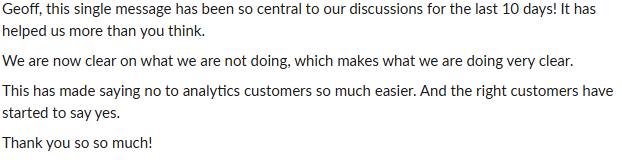
It is still early for the startup I was helping, but a week and a bit later they came back with this:

Hopefully this perspective helps other operators, too!

Going to America – online business from down under

<Update> Dec 2012:

So, it looks like Christmas has come early. As mentioned in my April update below, the SSN barrier has been impossible to overcome. Until now. Thankfully, the legends at Stripe (Disclosure – AffinityLive pays them a lot of money, they don’t know we exist) have changed things – as long as you have a US bank account, you can enter 0000 as your last 4 digits of your SSN and get an operating account! I strongly recommend my friends at Silicon Valley Bank to set up your account with them – NOTE that you don’t need to have an LLC or a C-Corp to open an account with SVB.

</Update>

<Update> April 2012:

It is impossible to get a merchant account and accept payments in US Dollars without a Social Security Number (SSN). I’m not 100% sure if this is because of issues around the Patriot Act (no sending money to Iran or Korea, or remaining axes of evil), general money laundering, or because the back-end providers (I’m told there’s really only a couple of them who handle everything in the US) require it and every bank and gateway as to play by their rules.

I know this sounds silly, since a company doesn’t have a social security number (only people with the right to work in the US can get one), but it is just the way it is.

At this point, you’ve basically got four choices:

  1. Use PayPal (where the customer leaves your site) and accept their credit card in US dollars. You’ll get a horrible exchange rate and a pretty poor user experience.
  2. Go with a “reseller” and pay a high commission fee. I looked into FastSpring at the time.
  3. Find someone who trusts you and use their SSN to open an account with someone like Stripe, or
  4. Move to the US on an E-3 Visa and get a Social Security Number yourself.
Sorry I don’t have better news.
</Update>

Running an Australian business with Australian customers is great – you can get trading with an ABN in minutes, and while the GST caused us all a lot of grief a decade ago, it now enforces a fairly simple discipline that keeps your business in check. Hell, if they’d just get rid of payroll tax that creates an incentive to move jobs offshore, and insist that corrupt union reps have a ‘fiduciary’ duty to look after their best interests of their members rather than their own political careers, we’d be set.

Unfortunately, though, running an Australian business in a global market sucks. A lot.

This post tries to outline an approach to setting up your Australian internet business so that you can trade on close to a global market scale, competitively. And that means being able to price your product in US Dollars, and get paid in US Dollars, without getting completely screwed by transaction, currency exchange and lots of other fees.

This post is a work in progress, and will be updated as better advice and the pain of real world experience corrects assumptions/guesses. If you’ve got something to ask or contribute, please do so in the comments.

Getting Paid in USD

When it comes to the global marketplace – particularly online – the only game in town is US Dollars. A big chunk of the market is in the United States, people who aren’t are largely aware of how to convert from USD into their own currency, and most importantly of all, when prospective customers are comparing offerings and prices, they’ll be benchmarking your offering against your competitors, who’ll be pricing in USD.

If prospective have to think and convert your currency of choice into USD for comparisons and then their own currency for the cost to them, they’re probably going to have to reject you.

So, you need to get paid in USD if you’re selling online to a global market.

There are roughly four ways I’ve found to get paid online in USD as an Australian.

  1. Use a US Gateway and set up a US entity
    This method means getting a business, a bank account and a tax identification number set up in the US. It involves cost, paperwork and dealing with the IRS. However, it also means you can access very competitive pricing from gateways – the people who link your website to the credit card payment networks and thus get money into your account. A couple I’ve found – Cocard and Authorize.net in combination – are going to cost me US$18/month and their fee is only 0.15% above the credit card company interchange rate. Pretty compelling, but now your business has two bank accounts, two legal entities and two currencies to do accounting for, not to mention the risk of double taxation and other inter-government scams.
  2. Use a European Gateway and set up an EU entity
    The next option I’ve come across still involves creating an entity, but in this case it is more of a piece of paper entity. No bank account, no legal structure, no double accounting. As far as I can tell, you pay a small fee to someone like simpleformations.com, and then you find a company who’ll give you a merchant account such as www.nochex.com who can take credit cards, and they’ll deposit the funds as a wire transfer into your Australian account.
    Unfortunately, all the options I have prices for at the moment have a minimum monthly transaction of A$3000 or so.
  3. Use an Australian Gateway who supports multiple currencies
    As far as I’m aware, the only option open to Australian businesses who want a merchant account that supports multiple currencies is the National Australia Bank. I’ve made an enquiry to find out what the current state of affairs is on this, everyone I’ve talked to who’s tried this has had a terrible experience. A search for “nab merchant account rant” on Google turns up gems like this and this. I’ll update this post if this option surprises me and becomes even remotely competitive, but I’m not holding out much hope.
  4. Use a US ‘Reseller’ style company to collect credit card payments on your behalf
    This option is lowest setup effort, but it also provides less control, is least professional for users and costs the most in transaction fees. Companies like Plimus or Fastspring are effectively becoming our retail or reseller front end, reselling our product, and so all client interactions and payments go through these companies. They also charge up to 10% for their effort (and risk taking) getting between you and your customer, which while compared to traditional retailing and channel’s isn’t crazy, but they’re not actually finding you customers and handling client support the way a regular retailer or reseller would; 10% for payment processing is very high. If you’re only doing small amounts of revenue, this might work, but if you’re trying to build a business that is more than a hobby, this is a stretch.

Having reviewed a bunch of the crappy options, the direction I’m leaning towards is setting up a US entity, opening a bank account, and getting a tax identification number.

Having a US entity, bank account and tax identification number

The idea of this post is to save future Aussie entrepreneurs some of the hassle/drama/uncertainty associated with doing business globally. If you’ve got any knowledge of any of this stuff and could affirm or correct any of these assessments, I’d really love to hear from you in the comments or by emailing geoff.mcqueen – at – hiivesystems DOT com!

The following is what I’ve worked out through a bunch of research, a couple of hours on the phone talking to staff in the IRS, and reading ATO Tax Rulings.

While I recognise that spending hours on this while we’re trying to get AffinityLive ready for launch is a bit stupid – this is what you pay accounts for, right? – I’ve found in business that understanding the fundamentals of these sorts of things yourself is priceless – after all, as a Director, it is me, not an adviser, who’s on the hook. Additionally, whether it is in IP law or other areas, understanding the basics means I’m in a better position to assess whether one adviser or another is more expert, and thus make the best decision about who to go with.

US Entity

Business registration in the US is handled on a state by state basis. One of the most appealing states for registering your business is Delaware – their fees are low, they have no sales tax (whereas in California it is close to 20% and the state is still almost bankrupt), they don’t take to kindly to people suing company officers and they are “friendly” like the Swiss when it comes to confidentiality. Handy.

There are a bunch of different entity types you can register in Delaware. The most common types as far as I can tell are a C-Corp and an LLC.

C-Corp

A C-Corp is like an Australian Limited company. Note that it isn’t equivalent to a Proprietary Limited (Pty Ltd) company, as a C-Corp has to have officers, needs to file returns to the state, and a bunch of other stuff. Nothing too scary, but more formal than you’d be used to if you’re running your own Pty Ltd company.

The company can file its own tax returns with the IRS (Federal, not state).

A C-Corp can keep hold of its own money from a tax perspective, paying dividends only when it wants to. It also doesn’t have limits on the number of shareholders like some of the other structures, so it is a good type to use if you’re looking to raise a round of capital by selling equity to investors. This entity is pretty much what you’re used to with running an Australian company, but having a C-Corp makes the repatriation of funds to Australia a bit more interesting, and makes transfer pricing a potential issue, as the C-Corp is a full company, and your Australian parent operation may well be a shareholder – or the only shareholder – but the IRS will treat the C-Corp as its own entity.

A Limited Liability Company (LLC)

An LLC is a particularly curious beast. It is like a company in that the business shields the owners and officers from personal liability should the business fail and have debts. It can have a bank account and trade just like a regular business. However, it can’t submit its own tax return like a company and pay tax – instead, the profit that the business makes flows through to its “members” (like shareholders), and they pay tax on it just like it was any other form of income.

In this sense, an LLC is much like an Australian Trust structure. And the way the Australian Taxation Office treats these LLCs – also known as “hybrid vehicles” because they tend to be more like a partnership where the “members” or shareholders can be natural persons and companies – is pretty good from what I’ve read so far. More on that later.

Registration

Regardless of the structure you follow, registering the company in Delaware is fairly inexpensive; there are a ton of agents out there who’s job it is to do just this sort of thing.

Just one example is IncNow.com, and the cost of registering an LLC and being up and running within a week is under US$300.

Annual fees are in the range of US$120 – also fairly reasonable at $10/month.

You also get the forms you need to submit an application for an Tax Identification Number (TIN), which your merchant account people will need you to have  to set up your account with them.

Franchise & State Taxes

In Delaware, they make their money by charging a small “Franchise tax”. From my reading, this would be around $90/annum. Bugger all really.

IRS and Federal Taxes

While business setup in the US is a matter for the state jurisdictions, it is the Federal Government you really need to worry about. Like in Australia with the ATO, the IRS are very bureaucratic and hungry for your money.

Every year, they require all taxpayers in the US to pay income tax and file a tax return – this includes not just individuals, but also companies, members of LLCs, etc.

If you’ve got an entity and a bank account, odds are that means you too. I’ll outline a bit more of what I understand the alternatives and situation to be in the Tax Returns section below.

Australian Taxes, Dividends and Double Taxation

Of course, if you’re running your company/business from Australia, you’ll have your regular dealings with the ATO to worry about too. This in and of itself isn’t a problem, but bringing together multiple tax jurisdictions around your taxable profits is asking for trouble – if someone’s going to get f*cked, it is going to be you.

Tax returns and not getting double-screwed

While there are undoubtedly a bunch of issues to address with running an international business and dealing with governments, the one that I’m trying to get to the bottom of with this post is tax.

Basically, I don’t want to be paying tax on the same income twice, and where possible, I want to be paying the lowest rate of tax I can on hard-earned profits.

Situation

Everything from here on in is assuming we’re running the US operation through a Delaware LLC, with a bank account in the US, and credit card based income coming into this US bank account.

There will be a few thousand dollars a month – initially – of expenses in US Dollars, mostly things like hosting fees with our US hosting provider, and a few odds and ends like local US phone numbers and such. All other expenses – our rent, our staff costs for product development and client support – will all be in Australia and paid in Australian dollars.

All income for our AffinityLive.com product sold to clients outside Australia will come through this LLC, with clients paying recurring monthly, quarterly or annual subscriptions in the hundreds of dollars via credit cards per client.

As a result, it is expected that the US entity will be quite profitable compared to the Aussie HQ given its lower fixed costs.

Complying with the IRS

As far as I can tell, running an LLC means that you’ve got two choices – the LLC can submit its own tax return acting as a corporation – a 1120 form – or its “members” can submit tax returns for their own share of the income that is distributed from the LLC.

To simplify things, we’re currently planning on completing our US tax return using a an 1120-F form, which is what a foreign company completes to declare income earned through their business activities in the US.

The IRS agent I spoke to today told me that we’re effectively declaring the income as Australian company income, earned through US business activities, and the LLC in this case is a financially transparent entity that doesn’t complete its own tax return.

If you submit a corporate tax return as the LLC, you’ll be taxed on your profits the normal way; I think it is around 33% or so. Then, you can repatriate your after-tax income to Australia, and the IRS is pretty much done with you.

The standard tax year in the US is a calendar year; again, to simplify things, we’re going to complete an 1128 form to move our tax year to be July to June and thus in-sync with our Australian financial year.

Witholdings

In some situations – and I don’t quite understand thesem but they seem mostly related to property transactions? – the IRS will also withhold a percentage of your dividend on top of the tax they’ve already collected.

One of the reasons to go with an LLC over a C-Corp and to use the 1120-F form, completed as the Australian parent, is to avoid dealing with dividends and transfer pricing issues at all, so hopefully withholding won’t be an issue for us.

Foreign Tax Credit

Australia has a tax treaty with the United States, which means income earned in the US is taxed by the US, and once it is repatriated to Australia, you get a credit from the ATO for the tax you’ve paid.

In a way it isn’t quite this easy, as the ATO will actually “gross up” your dividend to put the amount the IRS took away from you back on, at which point the ATO will calculate the amount of tax payable as if it was all Australian money, and then it will credit you for the amount you paid to the IRS on the US income, and you’ll then owe the ATO whatever extra tax they say you owe them. I think this is there so that ATO gets to charge you Australia’s tax rate and get more money out of you for income earned in places with lower company tax. What I don’t know is whether the reverse applies, and the ATO will allow us to “deduct” all of US tax from our total tax payable (since the US rate is a bit higher), or whether the ATO will have it both ways – charging you more tax when the other country has a lower rate, and saying bad luck and quarantining foreign income and tax when there is a higher international rate.

No Franking Credits on US post-tax earnings

When a company declares a dividend and pays its shareholders, the shareholders need to account for that income as part of their normal tax return process, and pay tax on that income at their marginal tax rate. In Australia, a concept known as Franking Credits means that Australian taxpayers don’t have to pay tax on the whole amount of the dividend, since the dividend has already had company tax come out of it. It is a fair and great system, but unfortunately, the dividends that come as a result of internationally taxed income don’t get franking credits.

The following example, courtesy of a great newsletter from the team at Johnston Rorke, shows how you could lose almost two thirds of your hard earned profits to taxes due to this lack of franking credits. In the example, a foreign company makes a $1000 profit, the company tax rate in the foreign market is 35%, and the personal tax rate for shareholders in the Australian parent company is assume to be 40%. They’ve also included a dividend withholding tax rate.

As you can see, even allowing for the Foreign Tax Credit (note the “Nil” as the tax payable in the Australian company), the fact the shareholders have to pay tax at their full marginal tax rate (no dividend franking) means the effective tax rate on the end shareholders is a horrible 64.9%.

Things Still to Work Out

There’s still a lot of questions in the above.

I currently don’t have a good handle on exactly how the ATO will treat the income that comes via the LLC, as it is what the ATO calls a Hybrid Vehicle. While it would appear that the ATO will recognise the tax credit, I want to know for sure that this is the case, and unfortunately for me, researching this information on the web is pretty tricky, as the ATO has been making changes in the last couple of months – see http://law.ato.gov.au/atolaw/view.htm?docid=”AID/AID201077/00001″ for information that at the time of writing this post, was less than 3 months old.

I also want to understand the C-Corp scenario a bit better – particularly the dividend withholding issues – in case we find for legal or investor reasons we need to step up from an LLC to a C-Corp.

Another thing to look into is the option of setting up a structure in a tax friendly third country. Capital Gains tax in Australia is particularly horrible for entrepreneurs; not only do we have profits and incomes taxed, but if we manage to sell a company we’ve spent tens of thousands of hours and much personal risk building over many years, the tax man then wants to tax the money you get from selling the company at the top marginal tax rate in the year you sell it, in effect taking half of your pay off for success as tax. Other countries like Hong Kong and Singapore don’t have similar capital gains tax situations, however, since all the IP is currently owned by an Australian based company, and changes would need to be very well thought through as moving the holding company to another country would be expensive because it would trigger a capital gains tax event at the time of moving (since a company you set up in, say, Singapore, would be buying the Australian company, and the ATO would tax the shareholders – you – on that transaction even though no real money changed hands).

If you have any knowledge of how this is treated through first hand experience, or can point to an online article that explains it a bit more clearly than the ATO website tax rulings, I’d really appreciate you leaving a note in the comments.

Market Planning & Industry Categories – ANZSIC gets updated

I’ve spent a lot of time over the last few months doing marketing planning for Hiive Systems. Unfortunately, our product is targeted at the professional services sector – think consultants, creatives, advisors, and that sort of thing.

I’ve been really conscious in this marketing process NOT to just keep on doing what we’ve always been doing, so thinking about existing clients and then defining our target market based around them just isn’t good enough. I’ve been thinking through industries based on my experience and memory – almost brain-storming – but it is a pretty crap way to do things, and certainly isn’t an extensive data set.

One of the best ways to work would be to start with a big long list of industries, and then tick those sectors that look appealing for closer examination. Unfortunately, Google has completely failed me – asking for a “list of professional service industries” came up with a bunch of very poor listing websites.

Going to more official sources, the primary list I’m aware of, ANZIC, has always seemed to me to be pretty poor. There’s a special category for fur trappers, but anyone who does anything related to marketing – from consulting through to web development through and beyond to display advertising – is bundled into the same generic blob.

Today, however, I realised that the ANZSIC list was updated in 2006, to reflect the way that industries have changed and evolved since the list was last compiled in 1993. Now with a lot more detail in the service sector – the one that keeps growing in an advanced economy like Australia’s – this list is actually useful.

If you’re interested in seeing it for yourself, the ABS have a copy (publication number 1292.0) at their website. Hopefully if you’re trying to write a marketing plan, this will help you out too…

Research: what makes Facebook so engaging?

I’m writing a talk for the Enterprise conference at CeBIT, which tries to unpack what makes people spend hours and hours a week interacting with and updating Facebook, and what enterprise applications – particularly those that benefit from collaboration and which are often “higher level” tools rather than lower level tools necessary for a narrow job function – can learn from them.

I’ll be sure to share my thesis for what companies and enterprise applications can take away from Facebook – and the things they should make sure they leave behind – back here on my blog, but until then I’d really love to hear from you: what do you think makes Facebook so very compelling that keeps users “hooked” on it? Please share your thoughts in the comments!

Get your product/service into CeBIT's Webciety Showcase – FREE!

CeBIT is happening in a month and a bit in Sydney, and this year they’ve decided to focus the eyes of the tens of thousands of show visitors on a new showcase section, called Webciety. Webciety is going to showcase a dozen of Australia’s hottest web-software companies, and if you think your company deserves to be there, you can enter a competition to win the wildcard Webciety spot.

CeBIT is Australia’s biggest technology trade show, and it is on for its 10th year in Australia this May, between the 12th and the 14th. I’ve been involved in CeBIT in Sydney for a number of years now, and I even managed to squeeze in a visit to the original big-daddy CeBIT in Hannover, Germany in 2006.

As a tradeshow, CeBIT has a pretty broad range. While checking out the latest gadgets and marvelling at the ever-increasing size of flat panels each year has been pretty impressive, I’ve sometimes felt like software – particularly the web software space where I’ve always played – is a little bit scattered and doesn’t pack the punch it should.

This year, however, things are going to be different with the Webciety showcase.

The Webciety part of the show is designed to showcase how web-based technologies, products and services play an increasingly important part in our lives. After debuting in Hannover in March this year to an incredible response from visitors, the Australian organisers have decided to make the Webciety feature a centrepiece of the Australian show.

CeBIT is a pretty incredible event, with around 35,000 people attending Sydney’s show last year. In these tougher economic times, people are hungrier to find better ways to work, and if the experience at the 2009 show in Hannover last month is a guide, there should be a large number of high quality and very interested attendees heading down to Darling Harbour in May for this year’s show.

If you’re keen to get your company and its product/service included in the showcase, the good news is that CeBIT has set aside one of the Webciety spots as a “wildcard” entry. By nominating your company, you could find yourself included in this prestigious showcase, completely free! Entries close on Wednesday the 22nd of April 2009, so get in quick!

Warning: .cn domains lost within 72hrs of expiry

My company, Internetrix, has been expanding into the Chinese market gradually over the last year or so. Part of this has led us to register a couple of .cn domain names.

As a result of some plans we made a year ago, we registered a .cn domain name, in this case through GoDaddy. The domain name expired at around 11am on the 5th of March, so depending on the time zone, which would be only 30 and 54 hours ago.

Unfortunately, by the time I logged onto GoDaddy to renew the domain, it was too late. While domains I have decided not to renew from back in February were there asking for me to renew them, the .cn domain wasn’t.

It looks like when domains in .cn expire, they expire almost immediately. There is no way to renew them, and getting the domain back just now – around 2 days after expiry – cost me an additional US$50 in a redemption fee on top of the registration cost.

The very helpful operator from GoDaddy also told me that if I’d waited until tomorrow to call, they wouldn’t have been able to get it back for me. This means a domain could be irretrievably lost to squatters less than 72 hours after expiry.

This might be different for different registrars, and whoever GoDaddy use is particularly fierce with their suspension, but either way, I’d strongly recommend anyone starting to dabble in the .cn namespace be very, very careful and dilligent about their renewal handling processes.

Mike Arrington's Time Out and the decloaking the mob with Torches & Pitchforks

I wasn’t that surprised to read Mike’s post today about some really bad stuff happening over the last 6 months.

I didn’t know the details until I read them on TechCrunch, but I knew something was up when I messaged him to let him know I was going to be in the Valley for a couple of weeks in November. To my surprise, he told me he was going to be out of the state, at his parents place, and this was with months of advance warning. The Mike Arrington I know doesn’t make many plans that far in advance, and he’ll the first to admit that being right in the middle of Silicon Valley has as much to do with Techcrunch’s success as the many other factors. Being out of town – and the state – for months didn’t seem right.

I thought it might have been family stuff – I knew where he told me he was going to be was his parent’s place – and was hoping it wasn’t bad news or health stuff with him or his folks, and instead that he just needed to get out of the Valley to get out of the echo chamber for a while.

Of course, little did I know it was work related, and he was trying to get away from it, but instead of another Vulture piece from ValleyWag or a hatched job from the clearly jealous and much less talented writer, Betsy Schiffman, it turns out someone with a felony, and gun and an axe to grind was stalking Mike and his staff.

I’ve lived as a house-guest of Mike’s on a number of occasions, initially for 3 month stint in early 2006, when TechCrunch was less than 6 months old, and during that time I felt like I got to know the guy really well. We chatted about times before Techcrunch, women and relationships, lessons from previous business ventures and more. Those were personal conversations, and they’re going to stay that way.

My point is, however, that I got to get to know a person, a man I regard as my friend, thankfully for me at a time when he still “assumed most people were essentially good, and assumed that an individual was trustworthy until proven otherwise”. I saw someone who’d always take a contrarian position and get you to justify it. I’d watch – and cop – him taking the piss out of people, but we’d give as good as we got. I reckon he’s got more than a small potential to become an honourary Aussie: he didn’t care for status/authority, is direct, and loved to stick it to the man, which in his industry, is the incumbent media outlets. Pure Aussie in my books.

I also saw up close just some of the untrustworthy people, the types who lie even when the truth will do just as good a job, who’ve tainted his perspective. I’ve been frankly stunned that such an insightful and intelligent guy could be so trusting of people who’ve since screwed him over. And still he didn’t raise a finger in anger or retribution using his extensive online influence.

I’ve watched from afar as one storm or another has erupted online as people struggle to realise that just because its easier to click a mouse button, it doesn’t make it any less of a fight, and reflected that, with the exception of the stouch with DEMO, none of those fights were of his making. Sure, he’s no shrinking violet – he’s an attorney who loves a fight as much as the next lawyer, but more for the challenge than for the desire to stand upon the head of a lifeless opponent – but frankly, the vast, vast majority of the attacks and abuse levelled at Mike over the last couple of years have been way off base.

So, what’s the deal with these attacks? Given we’re talking about real world threats and attacks, its really worth having a look at them, and potentially shining a bit of light on the attackers. I believe they fall into one of three categories:

  1. Jelousy and Self-Interest – this one is the de rigueur attack motivation for the journalists out there covering tech. Many of them represent old-media, who see the competitive pressure of TechCrunch to be more than a little intimidating. The story I read on SMH today over lunch almost made me choke: headlined “Tony Soprano of Bloggers Faces Death Threats“, and in a piece that characteristically didn’t link to its sources, feature quotes taking shots at Arrington, including the one used in the headline, from other traditional, dead-tree media, who’ve got a pretty clear self-interest in taking him down. I thought this was a bit rich given most tech stories I’ve seen in SMH Tech News lately have been rehashes of TechCrunch pieces with a 12 hour delay and no links to sources. Moving away from traditional media to the other tech bloggers, a decent amount of the attacks are motivated by jealousy. And in the cases where they’re really legitimate differences of opinion, rather than just hit jobs, things are resolved amicably, and mostly in person. I enjoyed lunch with Mike and Dave Winer not two months after this comment’s little dust up, and there were no hard feelings at all around the table in Palo Alto.
  2. Bitterness of Rejection – there’s been a few recent posts about how stupid it is for startups to pin all their hopes on success, interest from VC’s and the implicit legitimacy of a positive review on Techcrunch. I can see how a want-re-preneur might get angry and upset about getting passed over, but if their key to success was a favourable Techcrunch post, I’d argue they don’t really have a business, just a fantasy of rock-star success and a Tesla in every garage. This sort of bitterness is just sour grapes (ok, enough taste metaphors already). The guy who did the spitting might have been responding to the bitterness of rejection, or he could have just be someone acting out the next point…
  3. Tall Poppy Syndrome – anyone who’s spent any time with Mike knows he isn’t a geek, programmer or deep technologist. To my knowledge, he’s never pretended to be. He does business analysis of businesses that just happen to be in the tech scene. Most of the flames I see posted in comments are either from people bitter after being rejected, or just pissed off that some guy who doesn’t know Perl from Python commands so much attention in the tech world. If you’re some random hater who’s rejoycing that Arrington is ‘out’ because you don’t think he knows tech enough, my suggestion is to think about what you’re going to do when you get pink-slipped because the business bit that pays for your lifestyle doesn’t work out, and hope that XKCD remains free so you can at least have some humour.

Anyway, the key point I’m trying to make here is that Mike’s a great guy: within 10 mins of meeting me and my business partner in Palo Alto, he offered us his house for as long as we needed it. All this stuff about Tony Soprano is just plain bullshit peddled by people with their own agenda, and if we let the bitter, jealous and tall poppy types continue with their baseless tirades without any accountability, we’re going to loose more and more good people.

Lets hope the serious stuff of the stalking ends, and for personally, I hope those enjoying the specatle of watching one of their biggest competitive threats bow out (hopefully temporarily) wake up with a nasty hangover tomorrow when they realise their rehashed and late stories, with little analysis, depth, opinion and conviction, supported by a business model more conflicted that Arrington’s ever was, is crumbling around them.

Trademark Applications in AU and US

I recently got a letter from a law firm in the US, alleging that my new business, Hiive Systems, has infringed their trademark. Unfortunately for them, the best they could do in claiming a trade mark was allege our logo was similar to theirs (we don’t think it is), and even though our businesses are in different industries, they demanded we stop using our name, logo and relinquish our registered domains, or they’ll sue us under some loose Common Law precedent formed in 1870 or so when the US government sued a counterfeiter.

Anyway, this is all going to play out over the next few months, so I won’t name names or go into details here lest I prejudice things or give these guys cause to make the issue (more) personal, but the upshot was that I did one of those important and non urgent things, and registered my trademark for Hiive Systems, initially in the US and Australia, and soon via the Madrid protocol.

For the benefit of those that haven’t gone through the process, but have been thinking about it, here are a couple of notes/observations. The key point is that it isn’t that expensive, and it isn’t that hard – if you’ve got a brand you care about, you really should be protecting your rights through a trade mark.

Australian Trade Marks (via ipaustralia.gov.au)

The process of applying for the trademark was fairly straight forward. The online application form was quite user friendly, and they made it easy to upload files and search for categories you want your trade mark applied to, from within the application process/form.

What surprised me the most was the vast array of detailed classifications for trademark categories: while I had previously thought the applications were for around 45 “high level” classes of registration (such as Class 9 which includes computer software), there are hundreds of sub-classes, and each one you select using a checkbox costs you more ($120 a pop). For example, “software” as a search phrase returned more than 80 sub-classes of Class 9 alone.

Starting small, we’ve spent $240AUD on an application for two categories, payable by credit card, and now we wait for the examination process to unfold. So far, pretty easy, and if/when they get accepted, we’ll be up for $250/class to actually register the marks, and then $300/class/year to maintain them: a total startup cost of $370/class.

IPAustralia is currently estimating less than a 3 month assessment period, which is nice – if I’m lucky I’ll know the result by Valentines Day.

United States Trade Marks (via www.uspto.gov)

The US Trade Mark system was decidedly less user-friendly, however, with patience and reading the fine-print, it worked out well.

Much like the Australian example, there are hundreds of sub-classes that you can apply against with your Trade Mark application, and each of these has a cost attached: US$275 per sub class, using the online TEAS-Plus system, which is a little more demanding of what you give it (and which presumably saves the examiners time). The good news is that these fees also appear to cover the actual registration if the mark is accepted, which is a good thing, since they’re a fair amount higher than the Australian application fees.

One snag I got stuck on while registering was the need to declare the reason for the registration for each class – it was important to select one box at a time, and in my case, choose 1a) since we’re already trading, and then upload some proof that we were already using the mark, in our case, a screenshot from our application. This form and button processes was very poor on user friendliness, and I had to delete and re-add records after accidentally setting them to be 1b) (not in use yet) and start over.

The email from the USPTO states that it is likely to be about 5 months until the application even gets examined, however, when it comes to challenges on validity of the trademark, they’ll use the application date as their reference point. If I’m lucky, I’ll know the result before the start of next year’s ski season.