
Data’s Siren Song
More data and better analytics always sound like a good thing. They call to tech founders tempted to build analytics tools, and to ambitious leaders who want to be data-driven. Data promises clarity, control, and confidence – right?
Unfortunately, while they’re exciting to build and attractive to buy, almost no one really uses analytics tools unless analyst is literally in their job title.
I’ve seen it over and over again – and it’s how smart people get caught in the Analytics Trap. I was recently mentoring an awesome startup, and gave them this advice:
I think analytics as a category is one of the worst for any tech company (prob second only to devtools). It is because us nerds love to build cool stuff with numbers, databases and reports. And the market says “we need this, it will make us better if we’re data driven”. And then no one uses it. This is because people are already overloaded with information and trust their intuition more than data. Also, if data shows they’ve spent their career being lucky, not skilled/smart, that is a big blow to your sense of self. So, the space gets massive effort by smart people, selling the products is a big uphill push, and then the NPS and ROI suck. Avoid analytics.
Why We Keep Falling for It
For founders, analytics feels like the purest kind of product. It’s logical. Quantitative. Defensible. You can point to a dashboard and say, “Look – truth!”
For buyers, it feels like leadership. “We’re data-driven” is one of those phrases that looks great in board decks and job descriptions.
The problem is that everyone’s buying the same illusion: the belief that more data automatically leads to better decisions. It can, but it often doesn’t – not when finding the answers in the data requires more work and slower decisions.
Most people have learned to trust their intuition and experience because, most of the time, they’re making familiar decisions. They only turn to data when they’re facing a brand-new question – and that doesn’t happen nearly as often as we like to imagine.
The Confidence Illusion
Most people say they want data. But what they actually want is confidence.
They want to feel sure they’re doing the right thing, and while a dashboard can help, it isn’t going to take the fall if it is the wrong decision.
Unfortunately, while analytics can boost confidence around a decision, but it always gives you homework.
To be data-driven, you have to go looking for the insight, make time to interpret it, and then convince others to act on it. It’s valuable work – but it’s still work. And when the day fills up with meetings, Slack pings, and fires to put out, the homework always loses.
The Toothbrush Lesson
I first saw this twenty years ago, working with Google not long after they acquired Urchin, which became Google Analytics.
At trade shows, Google gave away bright orange toothbrushes printed with:
“Google Analytics: Use Twice a Day.”
Even Google knew analytics was homework.
If the world’s most data-driven company had to remind people to use its analytics product, it wasn’t a design flaw – it was human nature. Reflection is optional, and optional work never wins against urgent work.
Why Founders and Buyers Both Get Caught
Founders and buyers fall into the trap from opposite sides.
Founders overestimate rational behavior: “If we show people the data, they’ll act.”
Buyers overestimate their own discipline: “This time, we’ll actually use it.”
Both underestimate the cost of context-switching – of stopping to analyze, interpret, and decide. It’s not that people don’t value data; they just don’t prioritize it once the real world starts screaming for attention.
So the dashboards sit idle, and the engagement graphs slide down.
When Analytics Becomes Homework
A few power users go deep. After the implementation and training phase, users rarely log in. Beautiful emailed reports sit unopened, ignored or unsubscribed.
The product team notice and understandably focus on building what the handful of active users want. This 5% of power users want more filters, more charts, more advanced reports. The product gets smarter, but also harder to use, which means but the audience gets smaller.
You end up with a heads up display for highly-trained pilots instead of a useful tool for managers.
And that’s the fatal flaw: if the output of your product is a report, you’re in trouble. Reports make people stop to think; great products make people take action.
Escaping the Trap: Analytics in the Workflow
While most analytics tools fail, some succeed – usually because they’re part of an actual workflow.
Mixpanel works because you analyze to act. You build audiences, trigger messages, measure results. The analysis isn’t the end or something you do “when you have time”; it’s the source of the activity. The same is true for many fraud and security tools – they proactively tell you what’s happening and what you need to do.
PostHog solved it differently. They accepted that most users wouldn’t engage daily, so they built an open-source model where 95% can use it free and the 5% who care most fund the business. They didn’t fix behavior; they fixed the economics.
I loved using Heap at my last company, but PostHog is the clear winner.
The lesson? Analytics only works when it’s directly connected to action – or when the business model doesn’t depend on everyone logging in.
Intelligence, Not Analytics
A friend told me recently he’d been using ActivTrak for months – or rather, he had it installed for six months but hadn’t really used it.
After hearing about TeamScore, he decided to dig back into the tool he already had, spending hours exploring the reports. He found real value – insights he wished he’d seen sooner. But it also demonstrated the trap: value that only appears after you do the extra work.
We were talking about that experience, and he said ActivTrak had so much data – but what he really wanted was something to tell him what to look at.
I showed him a beta of our daily AI summary in Slack, and he both laughed and winced:
“That’s exactly what I needed all this time.”
That’s the difference between analytics and intelligence. One demands your attention to get any value. The other does some of the thinking for you.
The Hard Truth
Analytics promises clarity, but most people just want confidence.
The gap between what we say and what we do isn’t irrational – it’s human. Being data-driven sounds great until you realize it means assigning yourself more homework.
It is still early for the startup I was helping, but a week and a bit later they came back with this:
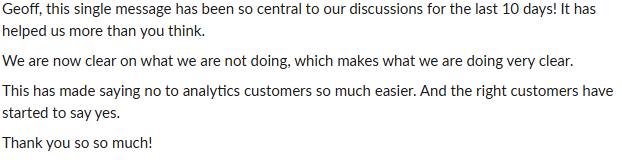
Hopefully this perspective helps other operators, too!
 geoffmcqueen.com