The Corrosive Spiral of Poor Performance

This is a true story. The names have been changed.

Any leader knows that having poor performers on the team is never good. But in a remote or hybrid team, it becomes downright corrosive.

When you’re remote, you lose most of your non-verbal cues – the nods, the tone-shifts, the energy in the room. You lose your peripheral vision. It becomes harder to see who’s working hard, who’s struggling and who’s quietly opting out. As I learned the hard way, a small minority of disengaged people can spread damage far beyond their individual lack of performance. The problem isn’t what these people fail to achieve in their roles – it’s the massive cultural decay that their behavior triggers.

Because modern teams are wired together by Slack, Teams, or chat tools, the corrosion spreads faster than ever. In an office, a bad attitude might infect a pod. Remotely, it can travel the entire company in an afternoon. Anyone can direct message anyone. There are no walls, no insulation, nothing holding back the damage.

This is the lesson I learned the hard way – and I want to share two stories in the hopes it helps other managers and leaders.


Oscar: The Human Barnacle

Oscar wasn’t a bad person. He was just the wrong person, in the wrong role, at the wrong time.

He joined the team early in his career, full of enthusiasm. Yet as the energy from his interview and the novelty of the role wore off, he slipped back into his natural state. Instead of asking, like many early-career professionals do, “How do I do great work and succeed?”, he started asking himself “How little can I do before anyone notices?”

The answer, in a remote world, was “quite a lot.”

His manager led a mostly green team and was learning how to lead remotely for the first time, too. It was a tough brief even for a seasoned operator. And Oscar took advantage of that, not quietly, but brazenly.

He’d brag to his peers about sleeping in until 11. He’d message them mid-week to say he was heading to the mountains – not on leave, just not planning to work. He wasn’t sheepish or sneaky about it; he was proud of getting away with it.

When someone acts without integrity in a culture built on it, it’s like throwing sand in the gears. The performance loss isn’t just in their role – it’s the damage it does to the culture. I heard later that he’d show up to mid-afternoon team meetings with bloodshot eyes and dilated pupils, clearly stoned, surrounded by people who were working hard in challenging times to make the company successful and their effort and equity pay off.

The peers he bragged to were stuck in a miserable bind. They couldn’t unsee what they saw, but they also couldn’t report it without feeling like a narc or a rat. And even the most committed team member would start to wonder: then why am I working so hard?

Oscar became a human barnacle – not just dead weight, but something dragging the team backwards. His behavior was holding others back.

Leadership wasn’t completely blind to the problem – we could sense something was off with the wider team performance – but without evidence, it was hard to act without offending a sense of natural justice. If you fire people because you feel like they’re not working hard, then your best people irrationally think they’re next and start looking for a new role. We were left in the worst place for any manager to be: suspecting a problem we couldn’t really prove.

All the while, trust was breaking down. The moral contract – the belief that if you lie, cheat or steal there will be consequences – had been violated. And because that breach was invisible to leadership but painfully obvious to peers, it began to eat away at everything good in the culture.

That’s the corrosive spiral: when people see others skating by without consequence, they stop believing effort matters. Once that belief dies, a performance culture follows.


Sally: The Reset

Sally’s story is similar, but with a happier ending: proof that with visibility, the spiral can be reversed.

Sally was one of those dream hires. Smart, self-starting, a natural operator who understood the product, the customer and the team. The kind of person who makes the rest of the company look good just by doing her job. Initially, she crushed it.

But then something shifted. The pandemic was behind us, the office was open, and she still chose to work from her small home studio less than a mile away.

Unfortunately, the cultural corrosion from Oscar and others like him set in. Deadlines slipped. Work quality degraded. The same person who once raised everyone’s game was now bringing it down.

Her manager, a first-time leader, tried to course-correct. Her exec, newer to the company, tried to help turn things around. Their coaching had been met with defiance. Before letting her go, they wanted to see if I had any ideas, given I’d worked with her longer and because they knew firing her would turn her life upside down.

Sally didn’t use to be an Oscar – and while she wasn’t performing, she was still smart and capable. At that point, we didn’t need another pep talk. We needed truth.

So I went to the data – the boring stuff every company already has but rarely looks at. The digital black box stored in log files of email, calendar and collaboration tools. Not to play detective, but to bring something objective to what had become a subjective mess of feelings, trust, and denial.

The story the data told was simple. Sally was failing and putting her job at risk because she wasn’t making an effort. The issue wasn’t about talent or potential – it was how she’d let a lack of visibility and accountability change her own expectations of normal.

Her manager and executive shared that data with her. The conversation wasn’t punitive. It was honest. Her leaders said, “We know how good you can be. But only you can choose to make an effort. Your job is at risk because of your performance because you haven’t been doing it, but we hope you want to change. This is why you’re being put on a PIP – to give you a chance to make that choice.”

We gave her a 30-day plan, grounded in data, not vibes. And she turned it around.

The same visibility that had once exposed Oscar’s rot gave Sally the mirror she needed to reset. She started showing up again, both literally and figuratively. The effort returned, and with it, the performance and pride we’d once admired.


The Lesson

Remote and hybrid work have made leading teams both easier and harder. Easier because talent can be anywhere. Harder because visibility mostly disappears.

When you remove visibility, you don’t just risk losing productivity – you risk losing trust. And when trust erodes, the spiral begins:

  • One person slacks off. Their peers notice.
  • Good people stop believing effort matters – or there will be consequences for being lazy.
  • Performance drops. Managers lose confidence. Clients get annoyed.
  • It is a corrosive cycle that won’t stop itself.

The Oscar problem is obvious if you can spot it. The Sally problem is trickier – it hides behind good intentions and old reputations. But both stem from the same root cause: lack of visibility.

That’s what makes poor performance so dangerous in remote teams. It’s not the output gap – it’s the information gap.

The good news? You can stop the spiral. Most people want to do the right thing. They just need to know their effort still counts, that it’s visible, and that everyone else is pulling their weight too.


Why This Stuck With Me

These two stories – Oscar’s corrosion and Sally’s redemption – taught me the same thing: performance comes from culture and without visibility, you risk both.

Visibility into effort and performance isn’t about surveillance. It’s about fairness. It’s about giving teams confidence that their effort matters, that integrity is rewarded, and that leadership isn’t blind to what’s really happening.

That’s a lesson I wish I’d learned earlier – but one that stuck deeply enough to shape what I’m building now.

Because no leader should have to find out their culture is broken because of a lack of visibility.

Fifteen Years of Paying It Forward

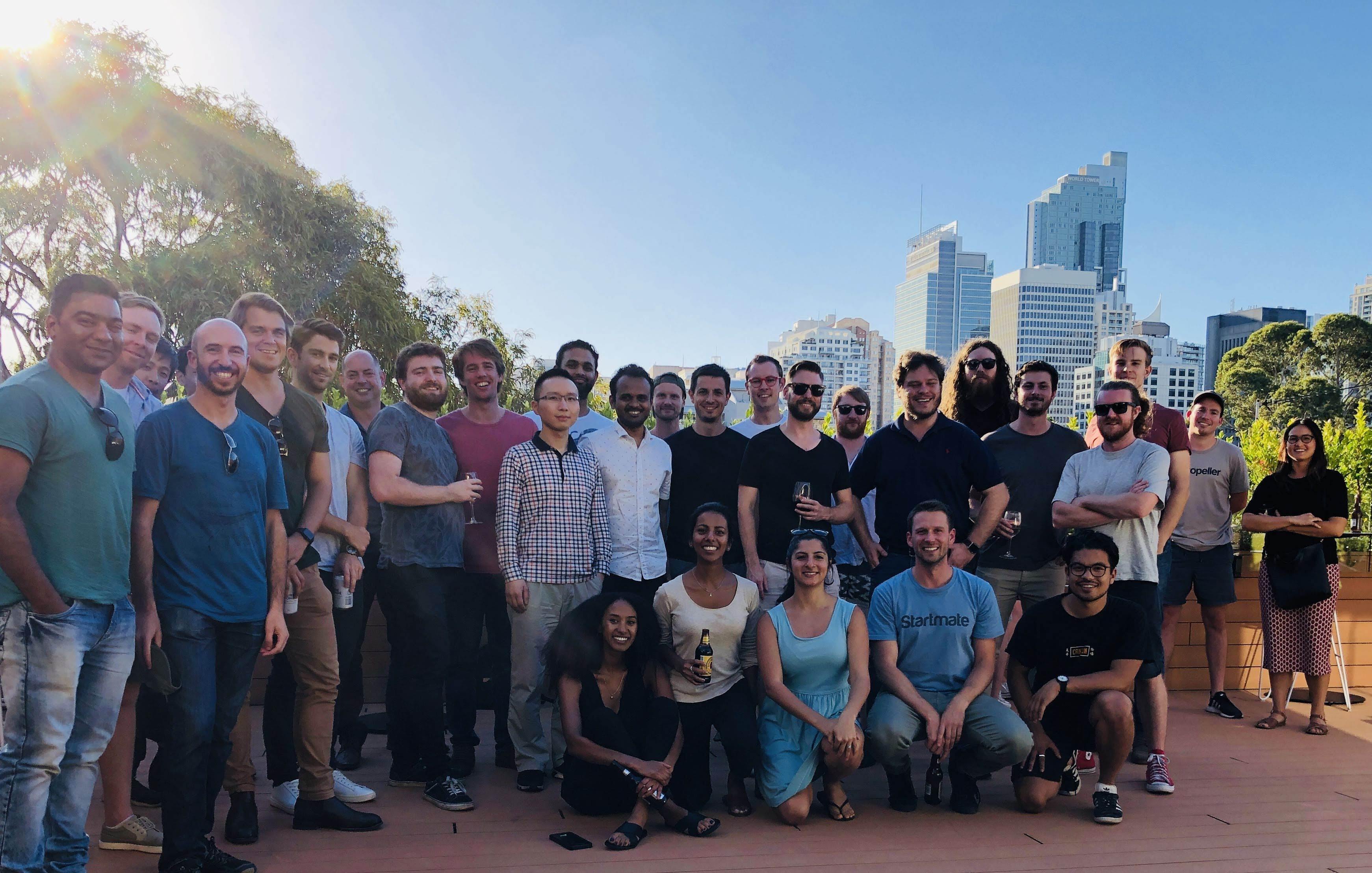
Every few months, I’m reminded just how special Startmate is – and Demo Day for the Winter 2025 cohort today is another one of those moments.

It’s a celebration not just of another set of ambitious founders, but of the community that has quietly shaped the startup landscape in Australia and New Zealand for the past decade and a half.

When Niki Scevak called and offered me the chance to invest in and mentor Australia’s first proper accelerator back in 2010, the local ecosystem was still young. There was talent everywhere – you could feel the energy at Silicon Beach meetups in Sydney – but we didn’t yet have the networks, mentors, and early-stage capital that make industries thrive.

From our cohort in 2011, it didn’t take long to see that Startmate was going to change that. It built the connective tissue our ecosystem needed: a program built on paying it forward, where experienced founders helped the next generation avoid the mistakes we’d already made. That simple idea and a lot of effort became a flywheel that’s still spinning – over 350 investments, companies now worth more than $4.5 billion, and a ripple effect that gave birth to Blackbird and a much bigger belief in what’s possible.

I’ve had the privilege of seeing that evolution up close – from the early, scrappy cohorts iterating, where each cohort made the pilgrimage to San Francisco and onto the well-oiled StartMate machine Batko leads today. Watching people like Casey from BugCrowd, Mike and Alan at UpGuard, Rory at Propeller, Michael at Morse Micro, and Alexandra and Nic at Workyard turn ideas into global companies has been a joy to see.

Since exiting Accelo last year, I’ve had the privilege to work very closely with the last three cohorts, leading the B2B stream and making it to my first Sydney Demo Day ever earlier this year! And being close to it again with more experience has reminded me that Startmate’s real achievement isn’t the portfolio value; it’s the culture. A community of founders and mentors who see helping others win as part of their own personal mission and higher purpose.

So to the Winter 2025 founders: enjoy Demo Day. You’re stepping into a lineage that’s shaped a generation of Aussie and Kiwi startups. Stay curious, stay close to your customers, and keep paying it forward – it’s what makes this ecosystem so special.

Chapter 4: Building Ascendius in Public with AI

After two decades building and running technology companies, I wanted to approach Chapter 4 differently – not by forgetting what I’ve learned, but by questioning everything I thought I knew, because I believe with AI, the rules have changed.

That’s what Ascendius is about – and this post is the first in a series about building it. My goal is simple: build a technology company that generates more than $10 million in annual recurring revenue with fewer than ten full-time employees. This isn’t unheard of, but it won’t be easy, and I’m excited to give it a shot!


The Hypothesis

The hypothesis behind Ascendius – the parent company of TeamScore and what I hope will become a family of sibling products – comes down to three ideas.

1. AI can make talented individuals 5x more productive.
While I’m not sure whether it will be 2x or 5x or 10x, I’ve already seen this firsthand through building TeamScore. AI tools make it possible to plan, write, code, and market faster than ever before – with quality that’s not “good enough,” but genuinely impressive. If that compounding advantage continues, we’ll be able to ship world-class products faster and cheaper than previously possible.

2. Post-AI companies have an unfair advantage.
Starting fresh matters. Established companies have to wrestle with technical debt, organizational inertia, and the politics of change. When you start clean, you can design every workflow, system, and even incentive around AI from the beginning. That’s not just an efficiency gain – it’s structural leverage.

3. Solving the CAC crisis is critical.
Even as it’s become cheaper to build software, it’s become harder to get it in front of the users who need it. Inboxes are scorched earth where we hover over the “report spam” button. No one answers a call from a number they don’t already know. The ad duopoly of Google and Meta extracts every last dollar of marginal spend, while Apple’s 30% outrageous “tax” continues to impair innovation.

So despite the cost of creation dropping, the cost of acquisition keeps climbing. That’s a crisis. 

I don’t know how to solve it yet, but I think the answer lies in combining audience-first thinking, cross-selling across a product portfolio, and AI-driven marketing that’s genuinely helpful rather than spammy. It’s one of the puzzles I’m thinking the most about.


The Productivity Promise

There’s no doubt we’re in the upswing of the AI hype curve. Anyone who’s used AI to do their job knows that feeling of awe when they completed a task way faster than before. However, a recent MIT report also found that 95% of corporate AI pilots are failing. But just like when the internet first emerged 30 years ago, it is clear to anyone who’s used it that this technology is powerful and transformative. 

One of the reasons I think big companies are struggling is because they’re trying to eliminate all of a lower-level role before applying the technology further up the expertise stack. This made sense in the industrial era, where robots did rote, repetitive tasks, but in the post-industrial knowledge economy, AI doesn’t completely eliminate one type of job at a time. Instead, it reshapes every job it touches and often has a bigger impact at the non-routine, non-rote work higher up the experience stack. In my experience, it doubles the productivity of almost every knowledge-based role – including up to the CEO and Board.

That’s the unlock. You can use AI for the things you used to hire an analyst, a marketing agency, or even a strategy consultant to do. For a few dollars a month, and instantly. 

AI is an exoskeleton for talented, creative people – not a replacement for them.

The companies seeing results are the ones where people seek the unlock instead of fearing it. Where AI isn’t a threat, but a multiplier.

At Ascendius, I use AI as an active partner for multiple hours every single day. I use it to brainstorm strategy, design architecture, refactor code, and, of course write 3 or more blog posts a week. The productivity gain isn’t about speed alone – it’s about the quality and breadth of what one person can now achieve.

But what I also know first hand is that “vibing” doesn’t work. I’ve been as excited as anyone to see a prototype come to life before my eyes, and the first version of TeamScore was an MVP alpha built super fast. But whether your coding or writing a legal brief or a consulting report, vibing doesn’t work. As a technology product, vibed code is unmaintainable and often insecure. As a marketing and sales tool, set-and-forget AI tools do more harm to brands and products than they save in time. 

However, if you use AI as a multiplier instead of a replacement, it is transformative.

For example, with TeamScore I was able to build a powerful, multi-region product with two dozen connectors in a programming language I didn’t know on a back end I’d never used in <6 months. It is how I was able to create a 30 page go-to-market plan that should take over 3 months in under 3 weeks. It is how I’ve been able to do detailed analysis of data in a couple of days that would have taken a couple of weeks, and of course how I’ve been able to write this and all of my other blog posts over the last two weeks while doing everything else.

That’s the productivity promise – and it’s already real.


The Advantage of a Clean Start

Most established companies are trying to retrofit AI into organizational structures, processes, and policies built for a pre-AI world.

Those structures weren’t designed to resist change – they were designed to manage risk and maximize the consistency of people. But now, every role, policy, and workflow is a piece of friction resisting change whether actively or accidentally. When people evaluate AI through the lens of how to do their job rather than asking whether their job should exist, progress slows to a crawl.

As Upton Sinclair wrote back in 1934,

“It is difficult to get a man to understand something, when his salary depends upon his not understanding it.”

It’s not malice. It’s human nature. It hasn’t changed in the 90+ years since Sinclair wrote it, and it isn’t going to change any time soon. 

For technology companies, the problem runs even deeper than processes, bureaucracy and politics. It’s not just the people – it’s the code.

Joel Spolsky, the doyen of software engineering and founder of StackOverflow and Trello, wrote the canonical warning more than 25 years ago in Things You Should Never Do, Part I . Rule number one being never rewrite your software from scratch. It was true then, and mostly still is.

But now established technology companies face a paradox. To take full advantage of AI, they need to modernize their infrastructure, data models, and workflows. Yet for any company more than a few years old, doing so requires breaking Joel’s first rule.

While you can bolt AI onto an old codebase, you’re not going to see many benefits – at least not compared to AI-native tech companies.

All of this gets even harder when the company is owned by private equity – where the plan to flip a company in 3-5 years isn’t compatible with the timeline or investment required to take advantage of AI. The founders are gone, the MBAs are in charge, and while they’re good at doing acquisitions and pricing strategy, product and engineering innovation isn’t usually their sport.

That’s why starting fresh is such a competitive advantage. In addition to being able to harness powerful tech like Cursor or Claude Code because your code isn’t legacy spaghetti, there’s also no team defending the old system, no hierarchy to preserve, no compliance department standing in the way of experimentation.

And it’s why this era feels so exciting.

Many of my friends who’ve exited their companies are back at it again – not because they need to, but because it’s rare to get both the experience of having built before and the freedom of a blank slate.

In a world of massive change, that’s the sweetest combination there is.


Solving the CAC Crisis

While AI promises to accelerate the product engine of a tech company, customer acquisition cost (CAC) remains a massive choke pointw

For years, the cost to build a new software product has fallen. But the cost to find customers has continued to increase.

Google and Meta’s action-based advertising duopoly soaks up every incremental dollar of acquisition budget, while Apple’s evil 30% tax and self-preferencing stifles innovation. Old sales playbooks continue to see diminishing returns: the inbox is scorched earth with cold emails quickly getting the “report spam” click, no one answers calls from phone numbers they don’t already know anymore because of scammers.

At the same time, AI will make it even cheaper to build new products. The result is a flood of competition fighting for the same attention, in the same channels, with the same tools.

That’s the CAC crisis.

If this era is going to produce a new generation of durable software businesses, we’ll need new distribution models to match, and being 5x as efficient in your biggest cost – payroll – provides the ability to invest in a better product at a better price along with new go-to-market tactics. These could include audience-driven portfolios, value-based bundling, or deeply automated go-to-market loops that are personalized instead of pushy. There’s also promise in new players providing new paths to discovery – as long as we can keep the AI-slop at bay.

I don’t have the full answer yet. But it’s one of the most interesting challenges in modern entrepreneurship – and I’m thinking about it every day.


Let’s Go!

We’re living through the biggest change in technology since the internet went mainstream 30 years ago – and it might prove even more consequential than that.

For builders, it’s a once-in-a-generation opportunity to rethink everything – not just products, but companies themselves.

So that’s what I’m doing. And if you’re building too, I hope you’ll come along for the ride.

The Analytics Trap

Data’s Siren Song

More data and better analytics always sound like a good thing. They call to tech founders tempted to build analytics tools, and to ambitious leaders who want to be data-driven. Data promises clarity, control, and confidence – right?

Unfortunately, while they’re exciting to build and attractive to buy, almost no one really uses analytics tools unless analyst is literally in their job title.

I’ve seen it over and over again – and it’s how smart people get caught in the Analytics Trap. I was recently mentoring an awesome startup, and gave them this advice:

I think analytics as a category is one of the worst for any tech company (prob second only to devtools). It is because us nerds love to build cool stuff with numbers, databases and reports. And the market says “we need this, it will make us better if we’re data driven”. And then no one uses it. This is because people are already overloaded with information and trust their intuition more than data. Also, if data shows they’ve spent their career being lucky, not skilled/smart, that is a big blow to your sense of self. So, the space gets massive effort by smart people, selling the products is a big uphill push, and then the NPS and ROI suck. Avoid analytics.

Why We Keep Falling for It

For founders, analytics feels like the purest kind of product. It’s logical. Quantitative. Defensible. You can point to a dashboard and say, “Look – truth!”

For buyers, it feels like leadership. “We’re data-driven” is one of those phrases that looks great in board decks and job descriptions.

The problem is that everyone’s buying the same illusion: the belief that more data automatically leads to better decisions. It can, but it often doesn’t – not when finding the answers in the data requires more work and slower decisions.

Most people have learned to trust their intuition and experience because, most of the time, they’re making familiar decisions. They only turn to data when they’re facing a brand-new question – and that doesn’t happen nearly as often as we like to imagine.

The Confidence Illusion

Most people say they want data. But what they actually want is confidence.

They want to feel sure they’re doing the right thing, and while a dashboard can help, it isn’t going to take the fall if it is the wrong decision.

Unfortunately, while analytics can boost confidence around a decision, but it always gives you homework.

To be data-driven, you have to go looking for the insight, make time to interpret it, and then convince others to act on it. It’s valuable work – but it’s still work. And when the day fills up with meetings, Slack pings, and fires to put out, the homework always loses.

The Toothbrush Lesson

I first saw this twenty years ago, working with Google not long after they acquired Urchin, which became Google Analytics.

At trade shows, Google gave away bright orange toothbrushes printed with:
“Google Analytics: Use Twice a Day.”

Even Google knew analytics was homework.

If the world’s most data-driven company had to remind people to use its analytics product, it wasn’t a design flaw – it was human nature. Reflection is optional, and optional work never wins against urgent work.

Why Founders and Buyers Both Get Caught

Founders and buyers fall into the trap from opposite sides.

Founders overestimate rational behavior: “If we show people the data, they’ll act.”
Buyers overestimate their own discipline: “This time, we’ll actually use it.”

Both underestimate the cost of context-switching – of stopping to analyze, interpret, and decide. It’s not that people don’t value data; they just don’t prioritize it once the real world starts screaming for attention.

So the dashboards sit idle, and the engagement graphs slide down.

When Analytics Becomes Homework

A few power users go deep. After the implementation and training phase, users rarely log in. Beautiful emailed reports sit unopened, ignored or unsubscribed.

The product team notice and understandably focus on building what the handful of active users want. This 5% of power users want more filters, more charts, more advanced reports. The product gets smarter, but also harder to use, which means but the audience gets smaller.

You end up with a heads up display for highly-trained pilots instead of a useful tool for managers.

And that’s the fatal flaw: if the output of your product is a report, you’re in trouble. Reports make people stop to think; great products make people take action.

Escaping the Trap: Analytics in the Workflow

While most analytics tools fail, some succeed – usually because they’re part of an actual workflow.

Mixpanel works because you analyze to act. You build audiences, trigger messages, measure results. The analysis isn’t the end or something you do “when you have time”; it’s the source of the activity. The same is true for many fraud and security tools – they proactively tell you what’s happening and what you need to do.

PostHog solved it differently. They accepted that most users wouldn’t engage daily, so they built an open-source model where 95% can use it free and the 5% who care most fund the business. They didn’t fix behavior; they fixed the economics.

I loved using Heap at my last company, but PostHog is the clear winner.

The lesson? Analytics only works when it’s directly connected to action – or when the business model doesn’t depend on everyone logging in.

Intelligence, Not Analytics

A friend told me recently he’d been using ActivTrak for months – or rather, he had it installed for six months but hadn’t really used it.

After hearing about TeamScore, he decided to dig back into the tool he already had, spending hours exploring the reports. He found real value – insights he wished he’d seen sooner. But it also demonstrated the trap: value that only appears after you do the extra work.

We were talking about that experience, and he said ActivTrak had so much data – but what he really wanted was something to tell him what to look at.

I showed him a beta of our daily AI summary in Slack, and he both laughed and winced:
“That’s exactly what I needed all this time.”

That’s the difference between analytics and intelligence. One demands your attention to get any value. The other does some of the thinking for you.

The Hard Truth

Analytics promises clarity, but most people just want confidence.

The gap between what we say and what we do isn’t irrational – it’s human. Being data-driven sounds great until you realize it means assigning yourself more homework.

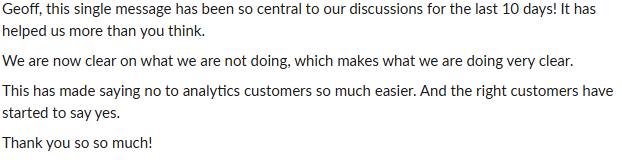
It is still early for the startup I was helping, but a week and a bit later they came back with this:

Hopefully this perspective helps other operators, too!

Fixing the Machine: The False Trade-Off Between Health and Success

Running a Company on Empty

Tomorrow marks 21 years since my dad passed away suddenly, and it feels like the right time to share what I’ve learned from finally doing things differently with my health over the last year and a half. 

For most of my career, I told myself I’d focus on my health “later.” Like a lot of entrepreneurs, I thought I was making a rational trade-off: push hard on business now, fix myself later when I’d exited or “had time”.

I’ve since realized it wasn’t a trade-off at all – it was a false choice that made business success less likely and a major health event more likely. Talk about a lose-lose

A few years ago, deep in the post-pandemic grind, I looked at the routine summary you get after a doctor’s office visit, and read at the top alongside my name and date of birth “non-morbidly obese male”. Obese was a rough word to see – and the ‘non’ was doing a lot of work.

So, while I did what I promised and focused on health after selling Accelo, I hope what I learned doing it is useful for other entrepreneurs grinding away every day – in short, don’t wait.


The Basics That Actually Work

The good news is, if you want to improve your health, the fundamentals work even if you’ve ignored them for years. Anyone who’s gotten in shape after a long period of being anything but will tell you it isn’t that hard – but it does take time and commitment. While there’s lots of nuance and advice if you’re an athlete, if you’re a “normal person”, it really comes down to three things:

  1. Eat less – and better – food. This one’s mathematical: if you consume less calories than you burn, you’ll lose weight. This is also where cutting alcohol consumption comes in – booze is super calorie dense. The main change I made was getting 150g of protein a day.
  2. Exercise regularly, especially resistance training. This isn’t actually about burning calories as much as having a strong structure for health, and because muscle burns a lot more calories just to operate, it helps with getting the calorie deficit. But you can’t train your way to weight loss.
  3. Prioritize sleep. There’s no bragging rights for pulling all-nighters the day before a deadline. Building a company isn’t like cramming for exams. You need sleep for good judgment and sound decisions.

Aside from promising myself I’d get in shape post-exit, I had another motivation to get healthy – my three girls. I knew if I didn’t do something about my health, I might not be able to walk them down the aisle one day.

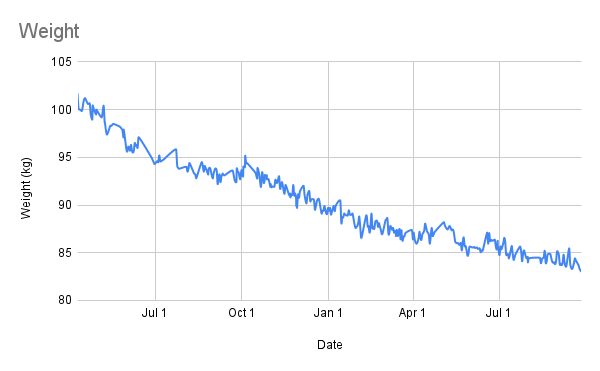
And there was a lot to do. When I started this journey in April last year, I weighed in at almost 102kg (224lbs). I was unfit, sleeping poorly and eating too much (especially snacking).


The New Operating System

While I set a big goal – to get down to 83kg (183lbs) for a healthy BMI for the first time in my adult life – I started small. This was about a sustained change of lifestyle and outlook, not a quick and temporary win:

  • April 2024 – Began on a GLP-1 medication (Ozempic), ramping up over a few months to 1mg/week. I hated needles, but loved the appetite control. It made calorie restriction easier, and that made exercise not just possible but actually enjoyable. There’s ways to do this that don’t break the bank, too.
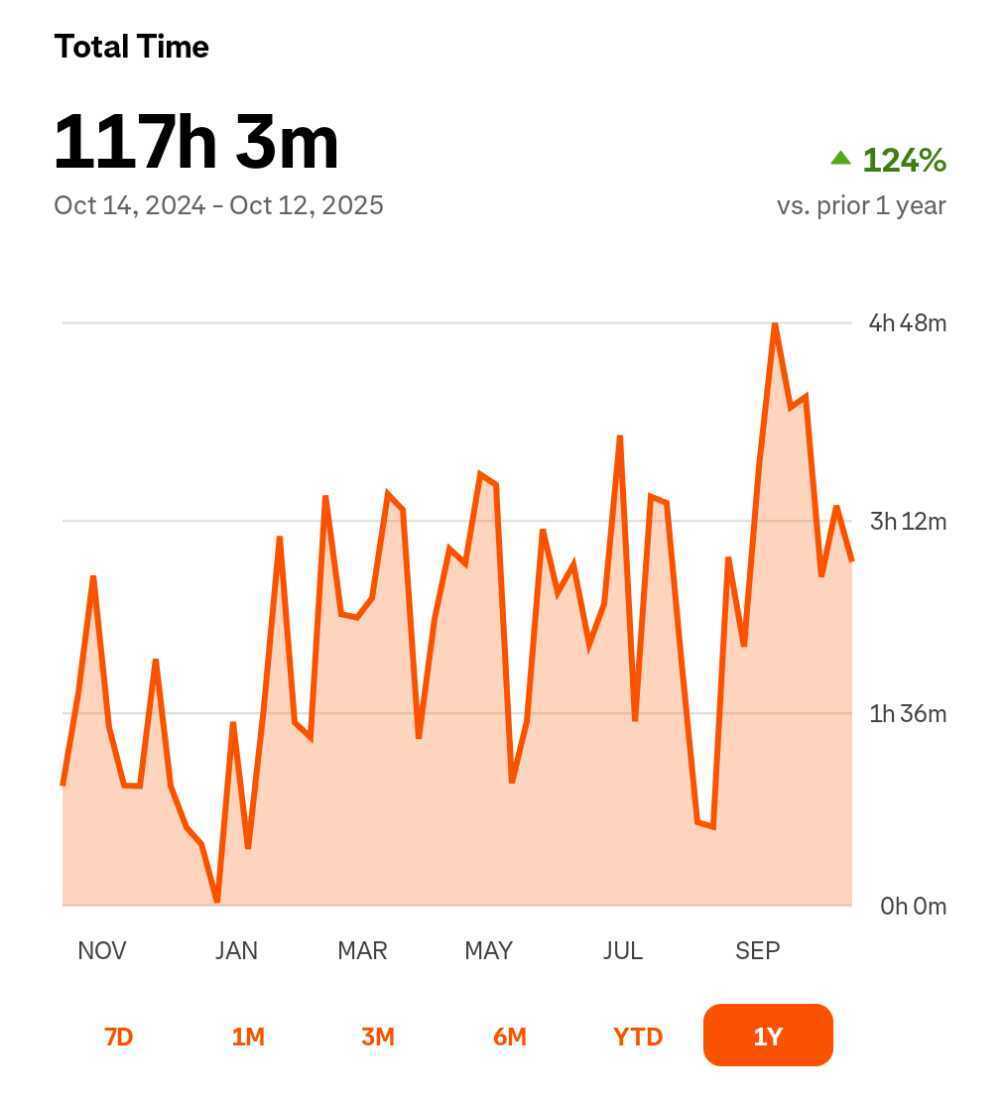
  • August 2024 – Joined a gym and started strength training with a trainer, Avishai. I knew almost nothing (and still have plenty to learn), and after he moved away in October, I used ChatGPT to take pictures of the equipment in my new gym and then create a workout plan, which I then loaded into Hevy. This syncs with Strava and Fitbit, and helps me track performance.
  • December 2024 – By the end of the year I was down 12kg (26lbs). For the first time in forever, I didn’t create an empty New Year’s resolution around “getting healthy”, but instead just had to stay the course. 
  • September 2025 – In less than a year and a half, I hit my goal! And while I haven’t set a new target yet, I’m now committed to working out at least 5 days a week and continuing to get stronger to be a better father, husband and leader.

While it feels great to have lost 18.7kg (41lbs) so far, the bigger benefit is how much more energy, mental sharpness, and focus I’ve gained. There’s no way those five extra hours I used to spend grinding on the business instead of exercising were worth more than the performance I’ve gained every other waking hour by making health a priority.


What I Learned (and What I’d Tell Other Founders)

Here are a few lessons that stood out along the way – and that I wish I’d understood earlier.

1. Your performance is the company’s performance.
You probably already know this, but when you’re the founder or leader, you are the company’s pace setter. If you’re tired, foggy, and sluggish, your team and decisions are too. You can’t lead on empty.

2. It’s never been easier.
Modern medicine, wearables and AI training tools have changed the game. GLP-1s make calorie restriction sustainable, and an Apple Watch, Fitbit, or smart scale gives more feedback than a doctor’s visit used to. ChatGPT can also help you put together a workout plan. You still have to do the work, but the friction is lower than ever.

3. Most advice is noise.
Like startups, 80% of the results come from doing the most important 20% of things consistently. If you read one thing, make it Peter Attia’s Outlive. Then:

  • Do a resistance workout 2-3 days a week. Lift weights or use machines: whatever works for you. The key is building strength for the long term, especially avoiding injury.
  • Do a cardio workout 2 days a week. 30 mins in Zone 2 (about 120bpm) seems to be the best advice.
  • Stay in a mild calorie deficit. This isn’t dieting or starvation stuff. Only fast if you can’t help yourself around food.
  • Sleep more than you think you can afford. With three young kids and a puppy, I’m still failing at this. But don’t stay up late grinding.

That’s it. The compounding is real.

4. Don’t wait.
I used to think I’d “get healthy once things calm down.” They never do. There’s always a product launch, a funding round, a fire to put out. You wouldn’t go on a road trip with empty tires – don’t try to build a company without also building your strength and physical resilience.


Where I Am Now

My VO₂ max has improved, my blood pressure’s down, and I can lift more than I could at 25. But I’ve still got a long way to go. My sleep is terrible (I’m lucky to average six hours each night), and wine on school nights is still a habit I haven’t fully kicked. But I’m operating at a higher level – physically, mentally, emotionally – than I have in a decade.

I’ve learned that getting healthy isn’t a side project or something for later. It is the main project – because without your health, you can’t build or lead anything that lasts.